
WTO reform after Yaoundé: What next for the multilateral trade order?
The failure of the WTO’s ‘reform ministerial’ deepens the strain on the global trade system. But it also points to a possible path for future co-operation among coalitions of the willing.
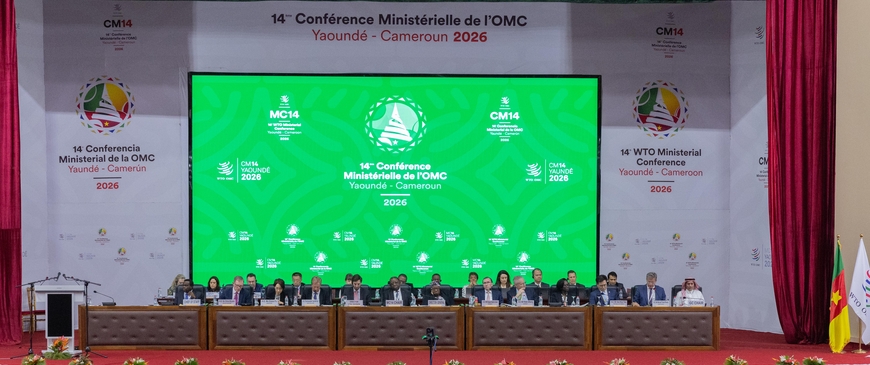
When trade ministers gathered in Yaoundé, Cameroon’s capital, in late March for the World Trade Organization’s (WTO) 14th ministerial conference, the global trading system was already under strain from every direction. Industrial policy was back in force, with the number of subsidy measures introduced each year around the world having more than tripled over the past decade. Tensions over China’s export-led growth model, America’s growing enthusiasm for sweeping tariffs and the long-standing paralysis of dispute settlement in Geneva, all hung over the meeting. Hopes for what was billed as a ‘reform ministerial’ were modest: not a major breakthrough, but at least proof that WTO members could agree on what ailed the system and how to begin fixing it. They could not. Instead, the meeting exposed the central weaknesses of multilateral trade governance with brutal clarity.
Hopes for what was billed as a ‘reform ministerial’ were modest: not a major breakthrough, but at least proof that WTO members could agree on what ailed the system and how to begin fixing it.
The ‘reform ministerial’ without a reform
Expectations had not been high to begin with, despite the opening call by the WTO’s Director-General, Ngozi Okonjo-Iweala, that the multilateral order has “irrevocably changed”. Members had hoped for only a modest outcome from four days of negotiations in Yaoundé: something that would preserve negotiating momentum, avoid the expiry of key decisions, and launch a structured process to discuss reforms that would carry the organisation to its next ministerial in 2028. The ambition was limited to a draft reform statement and work plan for further talks, not a grand bargain. But even that proved too much.
The clearest failure came on digital trade. A moratorium, in place since 1998, barring customs duties on electronic transmissions – covering everything from streamed content to digital services – expired after members failed to agree an extension. The US had been pushing for a longer extension, which was blocked by Brazil and Turkey. The moratorium has now technically lapsed, raising the prospect of tariffs in one of the fastest-growing areas of global commerce, at least until talks resume in Geneva. More damaging still, it showed that even one of the meeting’s most attainable outcomes was beyond reach.
There were never serious hopes of a breakthrough on the hardest questions of WTO reform, despite productive efforts by Norwegian ambassador Petter Ølberg, who headed the internal process leading up to the meeting in Yaoundé. Ministers had at least hoped to agree a short joint statement and a work plan for further talks. But the breakdown over e-commerce sank the joint text, with the US refusing to endorse the reform declaration without it. A meeting billed as ‘a turning point’ thus failed to deliver even the modest, process-oriented outcome that many had seen as the likeliest measure of success.
What made the collective failure in Yaoundé so revealing was the gap between the traditional issues that dominated the agenda – fisheries, agriculture, and the long-running e-commerce file – and some of the biggest issues of the day in global trade. Unilateral tariffs, subsidy races, export restrictions, the weaponisation of dependencies, and trade’s growing entanglement with security and technology all weigh on the system, yet barely featured in discussions. The 166-member body that was once the centre of global trade governance could not convene its members and create a process for how to deliberate on those questions. If one test of the meeting was whether the WTO could recover its deliberative function, it failed on that score.
Different views of the world, different views of WTO reform
The breakdown over e-commerce may have tipped the meeting in Yaoundé into failure, but the positions tabled by key countries showed that the sources of disagreement ran much deeper.
Washington arrived in Yaoundé with the most revisionist agenda. Donald Trump’s grievances with global trade have become familiar enough since the start of his second term: in his view, sweeping tariffs are needed to correct America’s chronic trade deficit, protect domestic producers and guard national security. Despite the US president's disdain for multilateral trade governance, his administration has been quietly re-engaging with the WTO. Last October, it appointed a respected diplomat as ambassador to the organisation, and before the meeting in Cameroon, it published two detailed papers with ideas on WTO reform. In its March 2026 paper, the US administration gave that instinct a more coherent intellectual gloss to push for WTO reform. Among its many complaints was a direct challenge to the core principle of ‘most-favoured nation’ (MFN), under which countries must treat one another equally and not raise tariffs selectively.
Despite the US president's disdain for multilateral trade governance, his administration has been quietly re-engaging with the WTO.
The Trump administration’s disdain for MFN is hardly new. Washington has already brushed arise this principle in Trump’s bilateral trade deals, imposing selective tariffs in ways that contradict the idea of non-discrimination that sits at the heart of the multilateral trade system. What is new is that the administration now dresses this instinct up as a theory of WTO reform. Suddenly solicitous for the integrity of a system it has done much to undermine, it argued that the WTO itself needed to “rethink how the MFN principle functions in its current form” and reconsider how it relates to reciprocity. Washington’s claim was that this ‘unconditional’ version of MFN lies at the heart of the world trading system’s problems: countries that tilt the level playing field through heavy subsidies or unfair barriers should no longer enjoy the same treatment as others. In practice, that was a thinly veiled reference to China.
Washington’s broader argument was that the world had fundamentally changed, while the WTO’s structure reflected “an era of deepening convergence” that no longer exists. In Cameroon, US trade representative Jamieson Greer wanted members to discuss whether MFN treatment could be “adjusted or made conditional”, and whether more club-based, “closed plurilateral” agreements might offer a way to move ahead on specific issues without waiting for consensus from all members – something that WTO rules typically require. The implication was clear: if the WTO cannot accommodate more flexible and reciprocal arrangements, negotiations will increasingly happen elsewhere.
The EU’s position may have been less assertive in tone, but it was not entirely different in substance. Brussels, too, came to the meeting convinced that the WTO risked drifting into irrelevance. Before Yaoundé, the Council of Ministers said the WTO was at a “critical juncture” and warned that without deep and comprehensive reform, it faced “diminished relevance”. The EU called for a reform of the dispute settlement system, fairer level playing field conditions, and institutional and decision-making reforms built around what it called “responsible consensus”.
In a nod to American concerns, Maroš Šefčovič, EU trade commissioner, also broached what had long been close to taboo in Brussels: whether the EU’s traditional commitment to MFN should be tied more closely to reciprocity. That caused some unease inside the European Commission, though it also won some credit with Washington: the US paper on WTO reform praised Šefčovič for describing “the world as it is, not as it should be” and repeatedly cited the EU’s shift on MFN as proof that MFN treatment shouldn’t be sacrosanct.
Maroš Šefčovič, EU trade commissioner, broached whether the EU’s traditional commitment to MFN should be tied more closely to reciprocity.
Yet, according to EU officials close to Šefčovič, the logic of the EU position was less to undermine the WTO system than to make room for the “more variable geometry” approaches sketched out in the Commission’s own paper: more plurilateral agreements that cannot be blocked by a single country, and more “club approaches among like-minded countries, where benefits are only available to participants, on a reciprocal basis”. Brussels may be still more attached than Washington to preserving the semblance of a rules-based order. But it, too, appears to have moved towards a more flexible version of multilateralism. The world has indeed changed.
China, for its part, has cast itself as the defender of stability in the WTO-led system. Beijing presented MFN as the bedrock of the WTO, called for fully functioning dispute settlement, and placed development at the centre of future reform. But Chinese officials also showed some openness to “agile decision-making at different speeds” and “flexible plurilateral initiatives”, perhaps acknowledging the growing appeal of moving ahead in smaller groups.
What Beijing would not do, however, was concede in any direct way that its own economic model was part of the reason the global trade system is under such intense pressure. Wang Wentao, China’s commerce minister, accepted that reform should address fair competition and trade-distorting policies, but he insisted that reform must “respect members’ different economic systems and stages of development”. China’s heavy industrial subsidies, managed exchange rate, and export-led growth model, were curiously unmentioned. Beijing, in other words, acknowledged that the system was under strain while rejecting the idea that its own economic model may be one of the causes.
Beijing acknowledged that the system was under strain while rejecting the idea that its own economic model may be one of the causes.
India and several other developing countries saw the issue differently again. Reform talks, as one diplomat described it, ultimately ran into “a US-India wall”, with New Delhi opposing a substantive reform work plan and resisting any approaches that, in its view, weaken “consensus-based decision-making” and narrow opportunities for development through trade. To India – which has long resisted efforts to loosen WTO decision-making and generously exercised its veto to stall conversations it did not like – plurilateralism and governance reform look less like pragmatic solutions than ways for bigger powers to dilute MFN, weaken consensus and move rule-making into selective clubs, with less regard for the interests of developing countries.
The breakdown in Yaoundé cannot be explained simply by the collapse of e-commerce talks. That may have been the trigger. But the deeper problem was that members arrived with irreconcilable ideas about what the WTO is for and what reform should mean in a more hostile world. In the end, ministers were asked to sign off on a one-page statement containing little more than aspirational language changes to decision-making, development, level playing field, and “foundational issues”. Even that proved beyond reach. When an institution can no longer agree on how to discuss its problems, any meaningful reform is hard to imagine.
What this means for the multilateral trade order
If this all sounds unduly bleak, it should not. There was some good news, too. A coalition of 66 countries – which includes the EU and China but not the US – agreed to press ahead with the interim E-Commerce Agreement (ECA), allowing progress on digital trade even after India blocked its formal adoption as a WTO-compliant plurilateral agreement. They will apply the agreement among themselves while still seeking, in time, to fold it into WTO law. That matters because it signals that new rules can still be written in new areas, even when unanimity is out of reach.
It also points to a new form of institutional innovation. Plurilateral agreements are hardly new – the Government Procurement Agreement (GPA), for example, has sat inside the WTO for decades – but traditionally such agreements require the consent of all members before they can be brought formally under the WTO umbrella. This time a coalition of countries moved ahead without that blessing, using an interim arrangement as a workaround. Progress may increasingly come through such ‘coalitions of the willing’, with countries joining forces on issues of shared interest, agreement by agreement, rather than waiting for everyone else to agree. The European Commission called this proof of the “scope for modern rulemaking in the WTO context”.
Progress may increasingly come through such ‘coalitions of the willing’, with countries joining forces on issues of shared interest, agreement by agreement.
A common objection to such plurilateral initiatives is that they weaken the very system they are meant to save. They create a ‘two-tier’ trading order, add to the spaghetti bowl of overlapping obligations, and leave smaller countries further behind. Those concerns are real. But a more generous reading, especially after the collective failure in Yaoundé, is that plurilateral deals may be the only practical means to keep co-operation alive in a world where some countries exercise their veto to block progress and wider reform, while others are increasingly willing to bypass existing rules when those rules no longer suit them.
There were other signs in the same direction. The stopgap substitute for the WTO’s defunct appellate body – the MPIA, or the ‘multi-party interim appeal arbitration arrangement’ – continues to attract members. The EU and the 12-member CPTPP group of countries in Asia-Pacific have agreed to work more closely on shared challenges, including on trade diversification and digital trade. All this points to the same broader pattern: willing countries moving ahead, often outside the WTO framework, while broad multilateral solutions remain out of reach.
The broader shift is hard to ignore. A growing share of trade already flows through preferential trade agreements, and now more global trade governance might take place among narrower coalitions of willing partners rather than neat multilateral solutions. That does not mean the WTO is about to disappear, nor that it has lost all value. But Yaoundé showed that the future of multilateral trade governance might depend less on what all 166 members can collectively agree than on whether smaller groups can move ahead without breaking what remains of a system that, for all its flaws, still delivers real benefits to most countries.
After the failure in Cameroon, US trade representative Jamieson Greer said that the WTO would play only a “limited role” in future global trade governance. That risk is real, which is why the organisation has to adapt. Its best hope now is not that it regains its old authority, but that it evolves into a more flexible role, serving as an umbrella under which future plurilaterals can shelter, so long as they support open trade. This is a thinner form of multilateralism than the WTO was once created to advance. But it may be the only kind now on offer.
Anton Spisak is a senior research fellow at the Centre for European Reform.
Add new comment