
One year liberation day: The delusion of transatlantic economic divorce
A year after Liberation Day, Washington and Brussels are still fighting each other – not China.
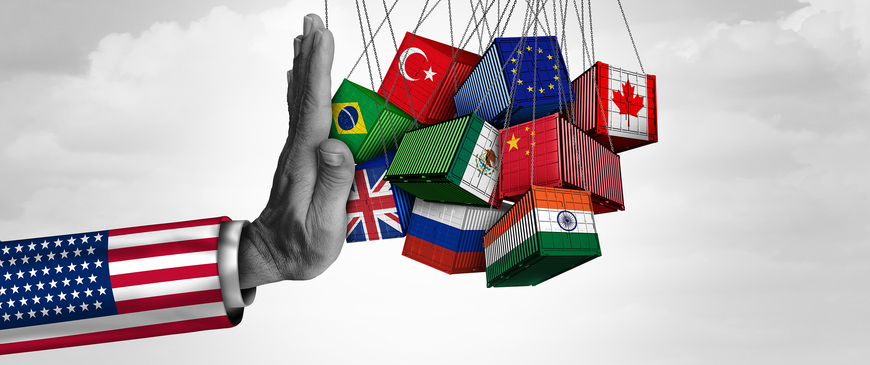
Liberation Day was meant to reset global trade. It has not. America’s fiscal and trade deficits remain near record highs, while China’s export surge continues unchecked, with Europe increasingly exposed. Washington misdiagnosed the problem, hitting allies as hard as rivals, and in doing so weakened the coalition it needs to address China’s distortions.
America’s fiscal and trade deficits remain near record highs, while China’s export surge continues unchecked, with Europe increasingly exposed.
The transatlantic relationship was further damaged when the United States threatened to invade Greenland and then went to war against Iran in concert with Israel, sending an energy shock through the economies of its allies in Europe and Asia. Both sides of the Atlantic may now look to unwind their economic interdependence.
The EU-US economic connection remains the world’s largest, however, with roughly $1.6 trillion in annual trade and several trillion in cross-border investment. European investors (including European custodians holding assets for international investors) alone hold around $8 trillion in US debt and equities, while Chinese investment in Europe is a fraction of that. The task is not to unwind interdependence but to manage it. That means rebuilding transatlantic co-ordination, sector by sector, around shared exposure to the distortions caused by China.
Global imbalances had been widening long before the second Trump administration took a sledgehammer to the trading system. The global economy rests on an unstable equilibrium: Chinese supply – fuelled by industrial subsidies worth 4.4 per cent of the country’s GDP – pairing with debt-fuelled US demand. Last year, Washington signalled it would no longer sustain this equilibrium and imposed broad tariffs on allies and rivals alike, culminating in Liberation Day.
Global imbalances had been widening long before the second Trump administration took a sledgehammer to the trading system.
As with its other trading partners, Washington went to great lengths to highlight Europe’s overall trade surplus, particularly in goods. It also pushed back against what it sees as regulatory discrimination against US companies, particularly in tech – a dubious claim given the US runs a large services surplus with the EU and that American firms dominate markets such as cloud computing, where three US hyperscalers hold two-thirds of the European market.
Finally, Washington sought to align Europe with a tougher stance on China. Putting more pressure on China together with allies to tackle distortions ought to be Washington’s most important objective. In practice, however, it seems largely to have abandoned it – with co-ordination on measures to counter ‘non-market practices’ (official policy parlance for China) being the last bullet in the EU-US trade agreement, outlining nothing specific on implementation. The trade conflict with Europe was also bound up with a parallel demand that the continent should shoulder more of the burden for its own security through higher defence spending.
With war raging in Ukraine, it was precisely its dependency on the US for its defence that led the EU to negotiate rather than retaliate against Liberation Day tariffs. The result was the EU-US trade deal signed at Turnberry, Scotland, in July 2025, in which America kept a baseline tariff of 15 per cent on most goods from the EU, and the EU slashed its (already quite low) tariffs on US imports to zero.
The deal is widely seen by European leaders as unbalanced but nonetheless better than no deal at all. Other US allies including South Korea and Japan struck similar deals with tariffs at or around 15 per cent. Even after the Supreme Court curtailed emergency tariff powers, European leaders have shown little appetite to reopen Turnberry. The European Parliament has now effectively signed off on it, albeit with conditions requiring simultaneous tariff adjustments, safeguards in case the US violates the agreement, and a sunset clause expiring in March 2028, requiring a new vote for any extension.
An unhelpful deal
Even if it remains in place over the long term, the Turnberry deal will fall short on its own terms in three critical ways.
First, if the objective was to reduce the bilateral trade deficit with Europe, it is puzzling that pharmaceuticals – one of the largest contributors to the US trade deficit – were largely excluded. For years, US firms have shifted intellectual property and profits offshore, and the 2017 Tax Cuts and Jobs Act reinforced these incentives by taxing foreign income more lightly than domestic income. In effect, the US ratified a pharmaceutical business model based on offshoring, particularly to Ireland.
As Council on Foreign Relations senior fellow Brad Setser has argued, this has driven a surge in EU pharmaceutical exports that is often mistaken for competitiveness, but in fact largely reflects US tax policy. Roughly half of the EU’s trade surplus with the US – around $100 billion – can be thought of as ‘trade in tax’. Strip out pharmaceuticals and the imbalance looks far smaller: EU goods exports fall to around $400 billion, against $300 billion in imports.
Second, the Liberation Day tariffs misdiagnosed Europe as a key contributor to global imbalances when the problem lies overwhelmingly with China.
As its real estate bubble burst in 2021, China shifted from property-led growth to focus even more heavily on exports – a shift fuelled by massive industrial subsidies and credit to industry. With domestic demand weak, exports have become the Communist Party of China’s main outlet. China’s $1.2 trillion goods surplus has surged to unprecedented levels: its manufacturing surplus now dwarfs those of Europe and Japan. In fact, China’s manufactured-goods surplus, now $2 trillion, is on par with Italy’s national income.
Europe is now confronting a version of the China shock that America absorbed two decades ago. But the roles have reversed: the first China shock hit labour-intensive sectors such as textiles and consumer electronics in the US. The second is striking the core of Europe’s industrial economy: cars, chemicals, machinery and aerospace – sectors China’s industrial policies have rendered increasingly competitive. Germany is ground zero. Its industrial production has fallen back to roughly 2004 levels, hit by an energy shock from Russia’s invasion of Ukraine and a persistent drag on exports from intensifying Chinese competition.
In principle, this should form the basis for co-operation: Europe and the US share an interest in curbing China’s subsidies, battling its currency distortions, and pushing the country towards raising domestic demand. For these reasons, the EU is de facto aligning with the US on steel: the bloc has imposed 50 per cent out-of-quota duties to curb Chinese dumping. But the Trump administration has nonetheless kept its tariffs on EU steel, and so far, is unwilling to compromise.
While China’s surpluses swell, Europe’s role in global imbalances is quietly shrinking, a shift that few in Washington appear to have fully grasped. In fact, the eurozone is the only large economy undergoing a true rebalancing. Germany’s decision to abandon the debt brake and enable around $1 trillion in defence and infrastructure spending marks a structural shift. Even the so-called ’frugals’, such as Finland, are set to loosen fiscal policy in response to defence needs. As a result, the euro has appreciated in value, Germany’s external surplus is shrinking, and the eurozone’s overall surplus has effectively disappeared, if one excludes the impact of Ireland’s tax distortions.
While China’s surpluses swell, Europe’s role in global imbalances is quietly shrinking, a shift that few in Washington appear to have fully grasped.
Europe’s defence policy is also reshaping the terms of the transatlantic relationship. The EU has introduced the €150 billion SAFE program, aiming to raise its share of defence procurement from European industry to at least 55 per cent by 2030. Washington may lament reduced purchases of American equipment, but cannot have it both ways: if it wants a Europe capable of defending itself, it cannot also expect it to remain dependent on US suppliers.
Washington’s strategy has left Europeans puzzled. Rather than building a joint front against China, the US has prioritised a deal with Europe that ultimately does little to address its trade imbalance.
One key casualty has been co-ordination on China’s currency manipulation. The US has traditionally led efforts in this area but is now absorbed in multiple trade conflicts. France has put the issue on the G7 agenda, and German Chancellor Friedrich Merz raised it during his visit to Beijing in late February. But Europe lacks the experience of global macroeconomic and foreign exchange co-ordination that Washington has.
Third, the transatlantic economy is marked by a division of labour neither Washington nor Brussels can simply wish away. Europe fills a gap in US industrial capacity, and the US fills Europe’s tech demand, making bilateral trade imbalances difficult to eliminate.
Led by Germany, Europe outproduces the US in steel, vehicles, ships, and civil aircraft. Manufacturing plays a far larger role in Europe than in the US: it accounts for 16.4 per cent of value added versus 11 per cent in the US, and employs around 30 million people compared with 13 million. Because American industrial capacity cannot meet domestic demand, the EU has long run a surplus in goods trade with the US, dominated by machines, cars and chemicals. Much of America’s advanced manufacturing has effectively been outsourced to Europe and Asia.
A call for co-operation
That structural reality now collides with Washington’s attempt to reindustrialise and rebalance this relationship. Tariffs alone are unlikely to bring manufacturing back at scale in an economy operating at or above full capacity, as shown by sluggish US manufacturing growth for most of 2025. If the US does not want to deepen its dependence on China, its best shot would be to continue importing Europe’s manufacturing surplus.
Europe, for its part, remains heavily reliant on the US for technology, artificial intelligence and software services. It may seek to de-risk from US finance, the dollar, and American tech, but US advantages in research and development, scale, and innovation, make any deeper decoupling unrealistic. Both sides therefore face the same choice: deepen dependence on each other, or on China.
Some in Europe argue the EU should pivot to China instead, following the lead of Canadian Prime Minister Mark Carney. Certainly, Europe’s dependence on Chinese technology will deepen as oil and gas prices surge from the 2026 Iran war. But the broader premise of the argument for a China pivot does not survive contact with economic reality. For a start, Canada sells commodities like oil, gas and metals China still imports, and Europe does not.
Europe’s dependence on Chinese technology will deepen as oil and gas prices surge from the Iran war.
Besides, China’s challenge is not only economic but strategic. A system that exports relentlessly, imports far less and channels subsidies into advanced manufacturing does more than distort trade: it reshapes the industrial base of its partners. The US offers a cautionary case. Despite unmatched defence spending, decades of offshoring have left bottlenecks in the manufacture of munitions, electronics, and machine tools, limiting the Pentagon’s ability to scale production.
Modern warfare increasingly draws on civilian technologies – semiconductors, batteries, software, and advanced manufacturing systems. China illustrates this convergence, moving from electric vehicles into semiconductors and from drones into autonomy and sensors. At a moment when industrial depth underpins military capability, the EU and US should share their industrial bases to gain economies of scale. Fragmentation among allies is strategically self-defeating.
What, then, could a common transatlantic policy look like? Both the US and Europe would benefit from tighter co-ordination through sectoral clubs, where they combine trade barriers against China with openness to each other. In this way, they can respond to China whilst preserving some of the gains from trade – greater market scale, specialisation and competition.
Under Presidents Trump and Biden, the US imposed high bilateral tariffs on China, only to find such measures mainly relocate final assembly to third countries such as southeast Asia or Mexico, rather than bringing them back to the US. The EU is about to learn that lesson the hard way. Its Industrial Accelerator Act equips base chemical and steel industries, clean technologies like heat pumps and wind turbines, and the automotive sector, with local content requirements cutting out China – while remaining open to the EU’s 76 free trade partners, inviting the rerouting of embedded Chinese content.
In the medium term, forming a ‘tariff club’ with like-minded partners would be a more effective response to China’s overcapacities. Acting jointly, the EU and US account for a large share of global demand in many advanced industrial sectors, and could leave Chinese exporters with few markets of comparable scale. In practice, this would mean that China absorbed more of the tariff burden through lower export prices and margins, rather than passing it on in full to consumers. The effect is not guaranteed, but it is far more likely under co-ordinated action than under unilateral tariffs.
There is a range of sectors where such co-ordination would be promising. It need not always be formal: a de facto club already exists in electric vehicles, where the US, EU, Brazil and Türkiye have imposed tariffs on Chinese imports. Priorities will diverge in some areas – such as wind turbines, which President Trump ideologically opposes – but align in others, including batteries, rare earths, and active pharmaceutical ingredients, where China’s near-monopoly poses a profound coercion challenge to both the US and EU. In advanced engineering sectors such as aircraft, both sides have an interest in competing with China’s Comac, whether through launch aid for Airbus or US government support to help Boeing recover and innovate again.
The litmus test is rare earths, which China has repeatedly weaponised with sweeping export controls, threatening to bring European and American manufacturing to a standstill. In principle, this is precisely where a transatlantic club should emerge: scaling up alternative supply chains, co-ordinating stockpiles, circulating technical know-how, and providing long-term price support to producers outside China.
Washington tried to counter China’s grip on critical minerals with the February 2026 Critical Minerals Ministerial, and the Minerals Security Partnership which preceded it, bringing together 55 countries and the EU. The Trump administration has intermittently embraced co-ordination, but often in ways undermining its own aims. It has prioritised domestic stockpiling, disbursed subsidies inefficiently, and signalled that co-operation with allies remains subordinate to ‘America First’ principles. Building rare earth supply chains is a decade‑long effort requiring trust. That trust is unlikely to materialise if partners fear the US is embracing its own resource nationalism.
For now, this state of affairs makes genuine co-ordination difficult. Europe will have to provide some of the demand for rare earths while other key partners – notably Australia and Canada – can provide some of the supply but are wary of being drawn into an overt anti-China bloc. But the underlying logic is solid. The scale of China’s dominance and the risks it poses to industrial and defence supply chains are simply too large to ignore. Over time, necessity is likely to force co-ordination on rare earths and beyond, whether through formal clubs or looser kinds of alignment.
The scale of China’s dominance and the risks it poses to industrial and defence supply chains are simply too large to ignore.
The irony is that the US and Europe are destined to rediscover each other not because trust has been restored but because the alternatives are worse. The premise of a transatlantic economic divorce is misguided. The relationship may be reshaped, but it cannot be unwound – least of all at a moment when both sides face the same strategic challenge from China.
This essay initially appeared in Commonplace.
Sander Tordoir is chief economist at the Centre for European Reform.
Add new comment