
Four years since Russia’s full-scale invasion of Ukraine: Four lessons for European leaders
Europe’s worst conflict since 1945 has already lasted four years. For their own security as well as Ukraine’s, European leaders must tilt the balance of economic and military advantage against Putin.
When Russian leader Vladimir Putin launched Russia’s full-scale invasion of Ukraine on February 24th 2022, many analysts – including me – assumed that organised military resistance would soon end, but that Russia would face a prolonged insurgency. Four years later, Ukrainian armed forces are still holding out, and fighting a largely conventional war. Russia controls less Ukrainian territory than it did in April 2022, and has suffered an estimated 1.2 million casualties – killed, missing or wounded. Ukraine has become a leading innovator in military equipment and tactics, and has moved from being a consumer of Western basic military training to playing a worryingly effective adversary force in NATO exercises.
Ukraine’s European partners must not treat the resilience of the country’s armed forces and civilian population as a justification for keeping the country on short rations, however. Doing too little to help Ukraine now still risks enabling an eventual Russian victory. After four years of war, European leaders need to grasp four lessons and act on them, for Ukraine’s security and their own.
Lesson 1: Ukraine’s security is Europe’s security.
For most European governments, supporting Ukraine still seems like supporting a football team: they are happy to pay to watch, but defeat would not be the end of the world for them. They are too complacent, however. Russia is already conducting a wider campaign of disruptive activity all over Europe. Its tools include disinformation operations such as the one spreading false stories about bad behaviour by Ukrainians at the Winter Olympics; drone incursions into NATO airspace; and terrorist attacks. Statements from the regime show that the Kremlin sees Ukraine’s European partners as more than opposing fans; it regards itself as already at war with them.
Whereas Western leaders still tend to see a sharp distinction between war and peace, the Russian leadership treats conflict as a continuum stretching from information operations to all-out warfare. At the very least, Russia’s current activities should be recognised as ‘shaping operations’, designed to weaken and confuse NATO countries and improve Russia’s initial position in any future military confrontation. If European leaders fail to connect Ukraine’s security and that of their own countries, they risk putting themselves at a considerable disadvantage in a conflict.
By inflicting heavy casualties on Russian forces, keeping hundreds of thousands of Russian troops pinned down so that they cannot mass on a NATO border, and attacking Russia’s energy and defence industrial facilities, Ukraine is reducing the threat to the rest of Europe. It is doing so at enormous cost. It has lost an estimated 500,000-600,000 troops – killed, wounded or missing. Given that Russia’s population is more than three times Ukraine’s, Ukraine cannot survive a long-term war of attrition on current terms. It continues to lose territory, albeit slowly and with occasional successes in retaking ground. It is short of infantry and struggling to mobilise more.
Western officials describe Ukrainian forces on the defensive along almost all of a long front line that is increasingly porous, as small Russian units gradually penetrate areas that Ukraine has too few troops to defend. Recent Ukrainian successes, caused to a large extent by Russia’s loss of access to Starlink satellite communications, are a boost to Ukrainian morale, but they are unlikely, on their own, to result in strategically significant territorial gains.
The resilience of Ukraine’s civilian population is also being severely tested. The current winter has been the coldest of the war so far, and according to Ukrainian President Volodymyr Zelenskyy, Russian drone and missile attacks have damaged or destroyed every non-nuclear power plant in Ukraine, leaving people freezing and in darkness for long periods.
European governments are making a serious mistake if they assume that Ukraine can hold out indefinitely, or that the effects of Ukrainian defeat would be modest and manageable. In reality, the consequences of Ukraine losing would be catastrophic for security in the rest of Europe, not least because Russian forces would be able to regroup, reconstitute and pose a significant threat to other states on Russia’s borders, including the Baltic states. Over time, they would be made stronger by controlling Ukraine and its resources, including its innovative and battle-tested defence industries.
The consequences of Ukraine losing would be catastrophic for security in the rest of Europe.
Lesson 2: Putin has not changed his objectives since 2022, and is only interested in peace on his own terms – which would involve reducing Ukraine to the status of a Russian vassal.
For the last year, the West has in effect been negotiating with itself: European governments and Ukraine have engaged in a diplomatic process partly designed to prevent US President Donald Trump from coercing Kyiv into disastrous concessions. Apart from securing red-carpet treatment at his summit with Trump in Alaska, Putin’s commitment to the process has been limited. He has focused on persuading Trump and his negotiating team – none of whom is an expert on the region – that responsibility for the war and for the failure to achieve peace lies with Zelenskyy, not with the Kremlin. He and his team have also dangled in front of Trump the prospect that a post-war thaw would create lucrative commercial opportunities in Russia. He has offered no concessions, nor has he indicated willingness to do so in future.
In February 2026, the Russian foreign minister, Sergei Lavrov, described the aims of the so-called special military operation – the ‘demilitarisation and denazification’ of Ukraine – as “unchanged” and “not open to opportunistic compromise”. While the US has pushed peace negotiations and Europeans have scrambled to stave off a settlement that undermines Ukraine’s security, Russia has stepped up its attacks on Ukraine, in particular against civilian infrastructure. The Russian delegation seems to have repeated its maximalist demands at the latest round of US-brokered talks, held in Geneva on February 17th and 18th.
Lesson 3: Trump is not on Ukraine’s side, or Europe’s.
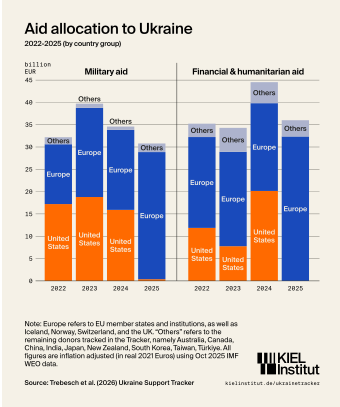
Since the start of Donald Trump’s second term, US military and financial aid to Ukraine has almost entirely ended, although vital intelligence support has continued (interrupted, fortunately only briefly, to force Zelenskyy to engage in peace talks). Trump showed in his first term that he felt more affinity for Putin than for the US’s traditional allies in Europe. The November 2025 US National Security Strategy makes clear that the Trump administration now sees the US more in the role of a mediator – seeking to prevent conflict between Russia and Europe – than as a fellow adversary of Russia, much to Putin’s satisfaction.
Since his return to office, Trump has regularly blamed Ukraine for starting the war, and put pressure on Zelenskyy to make concessions while making no demands on Putin. He has echoed Russian narratives suggesting that Zelenskyy is illegitimate – “a dictator” – because Ukraine has not held elections since 2019. Trump has reportedly threatened that, unless elections are held by May 2026, a mooted US security guarantee will be off the table – even though elections in wartime would be illegal under Ukrainian law, and could not be free and fair while millions of voters are refugees or internally displaced, or serving at the front.
Putin has meanwhile worked – successfully – to ensure that Trump sees it as reasonable to reward Russia for its efforts to occupy Ukrainian territory. Trump spoke in October 2025 of Putin having “won certain property”. In November 2025, the US put forward a 28-point plan, seemingly crafted mostly by the Russian negotiator, Kirill Dimitriev, that would have forced Ukraine to cede the critical ‘fortress belt’ of cities in the Donetsk region, including Slovyansk and Kramatorsk, that Russian forces have failed to capture in four years of fighting. Were Ukraine to surrender these areas, Russia would be able to launch a future attack from a much more advantageous position, with Ukraine’s main defensive lines already under Russian control.

In the context of his peace efforts, Trump – encouraged by the Russians – sees the Europeans as an obstacle, making it harder for him to impose a deal on Ukraine. The US National Security Strategy puts it starkly: “The Trump Administration finds itself at odds with European officials who hold unrealistic expectations for the war perched in unstable minority governments, many of which trample on basic principles of democracy to suppress opposition. A large European majority wants peace, yet that desire is not translated into policy, in large measure because of those governments’ subversion of democratic processes.” This passage would not look out of place in a statement from the Kremlin.
In the context of his peace efforts, Trump – encouraged by the Russians – sees the Europeans as an obstacle, making it harder for him to impose a deal on Ukraine.
Lesson 4: Russia is not invincible, and it can be deterred – but only by credible threats.
Europe is not as strong as it needs to be, but it is not as weak as its leaders seem to think it is. The fact that Ukraine – despite having a population less than a third that of Russia and an economy less than a tenth the size of Russia, when measured by purchasing power – has held out for four years shows that Putin can be resisted. The combined GDP of NATO’s European members, on a purchasing power parity (PPP) basis, is roughly five times that of Russia; their active armed forces outnumber those of Russia by several hundred thousand; and France and the UK have their own nuclear forces. If Ukrainian and European NATO forces were integrated, they would be twice as numerous as Russian forces.
Europe is not as strong as it needs to be, but it is not as weak as its leaders seem to think it is.
The difference between Russia and Europe, especially Western Europe, is preparedness and mobilisation. Putin has spent the last two decades militarising Russian society and the last four years militarising the Russian economy. Patriotic education and military training for children have expanded, particularly since the full-scale war began. A growing share of resources has shifted into the military-industrial sector at the expense of the civilian economy. On a PPP basis, Russia’s defence spending in 2024 is assessed to have exceeded that of all European countries combined.
Even though defence budgets have risen across Europe, the continent still depends on the US for vital capabilities such as intelligence, surveillance and reconnaissance (ISR) and command and control. At the same time, European defence industry is not yet set up for large-scale production of the weapons systems and munitions likely to be needed for anything other than a short war. Many Western European leaders have shied away from talking frankly to voters about the possibility of war, or about the inevitable trade-offs that increased defence spending means for other expenditure by their governments, including for public services.
The British public has unequivocally supported Ukraine, yet some of these trade-offs remain only half-discussed by the UK’s leaders. When Prime Minister Keir Starmer made a rare speech on national security at the Munich Security Conference on February 14th 2026, its message appeared aimed more at other European leaders than at the British public. The task of laying out the case for re-armament to British (and German) voters was left to the UK and German Chiefs of Defence Staff, in a joint article the following day.
Deterrence ultimately relies on both capability and the will to use it. European leaders have not shown a willingness to deter attacks on Ukrainian civilian targets, for example by deploying aircraft over Ukraine to shoot down missiles and drones, or by supplying Ukraine with longer-range missiles capable of disrupting Russian strikes at their source. The ‘coalition of the willing’ – a loose group of more than 30 countries, led by France and the UK, that has been working to put together a ‘reassurance force’ for Ukraine – has made clear that it would only deploy troops on Ukrainian soil once fighting was over.
The US and its European allies have all avoided direct confrontation with Russia for fear of escalating the conflict in Ukraine and triggering nuclear war. In doing so, they have acted as though there were not three nuclear powers (the US, the UK and France) in NATO, able to inflict as much damage on Russia as Russia could inflict on NATO. The risk is that Putin will conclude that he can attack a NATO country, and then deter allies from coming to its aid merely by threatening to target them with nuclear weapons.
The way ahead for Europe
Based on these four lessons, as the fifth year of full-scale war begins European governments should have four policy priorities:
1. Change the narrative around Ukraine. Leaders must stop pretending – to themselves and their voters – that peace is around the corner. They should do more to explain to populations what the real nature of the Russian threat is, and why Ukraine’s fate is so important to the security of Europe as a whole. Ukraine has shown over the last four years that it has agency, and by keeping Russian forces at bay, it has become a security provider for the rest of Europe. Thanks to its ability to innovate quickly in the light of battlefield experience, it is becoming an ever more valuable contributor as it shares tactics and technology with NATO and EU countries. Leaders should acknowledge its changing role – from aid recipient to security partner.
European leaders must stop pretending, to themselves and their voters, that peace is around the corner.
2. Stop relying on Ukraine’s ‘resilience’ to ensure its survival. Equally, European leaders should not look at the dogged endurance of Ukraine’s armed forces and civilians over the last four years and assume that it is infinite, and that Putin will eventually be forced to give up his attack on Ukraine. No-one knows the limit of Ukrainian stubbornness, but there is one. To paraphrase Ernest Hemingway, Ukraine could be defeated “gradually, then suddenly”. To prevent a decisive Russian breakthrough, European leaders should be prepared to intervene militarily to help Ukraine, without waiting for a ceasefire – starting by deploying air defence assets, including aircraft based in Poland and Romania, to reduce the impact of Russian strikes on Ukraine’s civilian and industrial infrastructure.
European leaders should be prepared to intervene militarily to help Ukraine, without waiting for a ceasefire – starting by deploying air defence assets.
3. Increase and enforce all forms of economic pressure on Russia. Western sanctions have not been a magic bullet, but they have reduced Russian revenues from oil and gas exports – by more than a quarter in the first 11 months of 2025 – and made it harder for Russia to procure the equipment, materials and components needed to maintain and ramp up defence production.
There is much more Europe can do, however. The EU’s 20th package of sanctions is intended to tighten the measures against the ‘shadow fleet’ of almost 1,500 tankers, often old and under-insured, that carry much of Russia’s oil exports to willing buyers like India and China. Additional sanctions will also make it harder and more expensive for Russia to acquire sanctioned items for military industrial production.
Enforcement of sanctions remains the weak link. Europeans have so far detained and penalised only one shadow fleet tanker. Stopping more would discourage others from carrying Russian oil, further hitting Russian revenues. More importantly, if Europe were to broaden its sanctions to refineries that buy Russian oil – not only banning European firms from buying refined products made from Russian crude oil – Russia’s foreign currency earnings and budget revenues would be hard hit. Sanctioned goods also continue to flow to Russia via third countries such as China, Türkiye, the UAE and a number of Central Asian states; European governments and the EU should strengthen end-use controls on sensitive goods and technology, and penalise both intermediaries in these countries and European suppliers that do too little to prevent goods being diverted, especially where there are clear spikes in demand from known transshipment jurisdictions used by Russia to circumvent Western export controls.
4. Have plans to cope with minimal US support if the war spreads to NATO territory. If Russia attacks NATO territory, Europe should assume that the US under Trump would provide minimal, if any, support. European countries are currently neither militarily nor psychologically ready to deter or fight Russia without the US, but they need to be. Both the US National Security Strategy and National Defense Strategy make clear that the Trump administration no longer sees Russia as an important adversary – a significant change from the 2017 National Security Strategy, in Trump’s first term, which bracketed Russia with China as wanting “to shape a world antithetical to US values and interests”. The 2026 National Defense Strategy describes Russia as “a persistent but manageable threat to NATO’s eastern members” and says that other NATO countries are “strongly positioned to take primary responsibility for Europe’s conventional defense, with critical but more limited US support”.
European leaders could not rely on such a weak statement of US commitment to deter Putin from attacking a NATO state. If Putin believed that the prize – destroying NATO’s credibility – were large enough and the risks of US and other allied intervention were manageable, he would not hesitate to act. Europeans need urgently to consider what it would take to deter Putin from escalating from sabotage and other forms of low-level unconventional warfare to all-out military intervention in a NATO country. They should accelerate the build-up of conventional forces needed to deter attack and if necessary to fight without the US.
The war in Ukraine has shown that any conflict may not unfold in ways envisaged by NATO planners. Without US support, European forces would have to fight under sub-optimal conditions. European leaders should learn whatever they can from Ukraine’s battlefield and defence industrial experience and, where feasible, integrate European and Ukrainian forces to face a common adversary. Finding alternatives to US enablers and replacing US forces and the US contribution to NATO’s command and control systems will not be cheap or easy, and most European leaders would clearly rather cross their fingers and hope that the next US president will be a committed transatlanticist. The earlier that Europe starts to prepare for a future in which Washington may choose not to involve itself in a European conflict, however, the more chance it will have of deterring Russia from trying its luck.
European leaders should learn whatever they can from Ukraine’s battlefield and defence industrial experience and, where feasible, integrate European and Ukrainian forces.
One of the key US contributions to keeping the peace in Europe during the Cold War was the nuclear umbrella it extended over its NATO allies. In the face of Putin’s nuclear sabre-rattling and amidst doubts about the US’s willingness to put itself at risk for the sake of Europeans, various ideas for European nuclear deterrents have been floated recently. For a single nation or a coalition to build up nuclear forces from scratch would be expensive, technically challenging, and a violation of the nuclear non-proliferation treaty. A more realistic course would be for Europe’s existing nuclear powers, the UK and France, to extend their nuclear protection to other European countries. In the 2025 UK-France Northwood declaration, they stated that “there is no extreme threat to Europe that would not prompt a response” by both of them. Between them, they need to have the range of delivery systems and the warhead numbers needed to provide a credible deterrent in a variety of conflict scenarios.
Conclusion
Regrettably, there is every chance that in a year’s time the CER will need to publish its analysis of five years of war in Ukraine. Without a more serious and sustained European effort to shift the balance – either by pushing Russia back (or helping Ukraine to) or raising the costs to the point where Russian casualties or the damage to the Russian economy become unsustainable – there is a real danger that next year’s analysis will report further Russian advances, more Ukrainian losses, and increased damage to Ukraine’s civilian infrastructure. But that outcome is not inevitable. Europeans can still learn the right lessons from the last four years and act on them. US attempts to make ‘peace’ with Russia at Ukraine’s expense will not deliver a durable settlement: they only encourage the Kremlin. Europe, including Ukraine, has a better chance of achieving a lasting peace by tilting the balance of economic and military advantage against Putin.
Ian Bond is deputy director of the Centre for European Reform.
Related content
Unpacking Europe: Four years of war in Ukraine
Add new comment