

The Mercosur deal tests Europe's geoeconomic ambition
The struggle to ratify the deal exposes a weakness in Europe's geoeconomic agenda: the EU can reach ambitious agreements with external partners, but it is poorly equipped to assemble and sustain the domestic coalitions needed to deliver them.
When Ursula von der Leyen addressed the World Economic Forum in late January, she cast the EU’s agreement with Mercosur as a “breakthrough” and a “powerful message to the world”. That message, she said, was that the EU was “serious about de-risking our economies and diversifying our supply chains”. Concluding negotiations after 26 years is an achievement, particularly in today’s more hostile global environment. But assembling domestic political support for the agreement has proven far more difficult.
In early January, the agreement scraped through the Council of the EU on a narrow qualified-majority vote – enough to move the trade-only elements forward, but without a convincing political mandate. Days later, a slim majority in the European Parliament requested a legal opinion from the European Court of Justice (ECJ). The risk is that a deal sold as geopolitics ends up mired in procedure – and that Europe’s credibility as an external partner pays the price.
The saga goes on
The EU and four Mercosur countries – Brazil, Argentina, Paraguay and Uruguay – opened talks in 1999, at the high-water mark of globalisation. The EU’s original goal was to deepen inter-regional links and anchor Latin America more firmly within a rules-based system. Mercosur countries, for their part, sought better agricultural access to the lucrative European market, and greater autonomy from the United States at a time when the Clinton administration was pushing a hemispheric trade agenda through the now-defunct Free Trade Area of the Americas. That initiative ultimately faltered because of irreconcilable differences over US agricultural subsidies and arrangements for intellectual and investment protection.
Twenty-six years and 45 negotiating rounds later, European and Mercosur political leaders have revived an agreement that most assumed would not survive the post-2009 backlash against globalisation. Concluding it now reflects a shared search for greater flexibility in a world where global trade rules are under pressure from both Washington and Beijing, trust is scarcer, and both sides want more room to manoeuvre. The symbolism was hard to miss: the agreement was sealed in Asunción, Paraguay’s capital, on the very day when US president Donald Trump threatened new tariffs on several European countries after they opposed his threats to take over Greenland.
Domestic EU politics, however, have not adjusted to the geopolitical stakes. Opposition to the Mercosur deal has been significant ever since the negotiations resumed in the late 2010s. When draft texts first surfaced in 2019, sceptical member-states led by France pushed back hard on agricultural and environmental grounds. Resistance returned with the final package in late 2025, as European farmers protested loudly against the deal. Even after side-assurances and political outreach to wavering capitals, the Council vote was narrow: five member-states (France, Poland, Ireland, Austria and Hungary) opposed it and Belgium abstained. That was enough for the trade-only elements of the deal to proceed, but it fell well short of a convincing political mandate. Soon after, a narrow majority of MEPs sent the agreement to the ECJ, splitting the Commission’s political base in Parliament. Depending on the court’s timetable, the referral could delay ratification by up to two years.
Domestic EU politics have not adjusted to the geopolitical stakes. Opposition to the Mercosur deal has been significant ever since the negotiations resumed in the late 2010s.
The parliamentary move was partly about the substance of the agreement and partly about the politics. MEPs on the far right and the political left have long disapproved of Mercosur; for others, including some in the governing coalition, sending the agreement to the ECJ was a way of reasserting its leverage over the Commission. The core legal question is whether the Commission’s decision to split the Mercosur package into an interim trade agreement and a broader partnership agreement fits EU law and competences. The Commission’s logic is straightforward: after years of bruising experiences with national ratification blockages, Commission lawyers sought to ringfence the trade deals from multiple national veto points. Under this approach, trade provisions that fall under exclusive EU competence can be approved by qualified majority, while other elements still require unanimity and national ratification.
What comes next
The Commission and European leaders must now decide how to proceed with ratification while the case is before Luxembourg-based judges. They have two broad options.
The first is to wait for the ECJ’s opinion – a low-drama route that keeps MEPs engaged and avoids an institutional confrontation. But it would delay ratification for at least a year, risking a loss of momentum and reinforcing a perception that the EU can negotiate ambitious agreements but struggles to ratify them. The Commission can ask the court to expedite the proceedings, but there is no guarantee it will do so. The second option is to move to provisional application of the trade-only elements. The Commission could provisionally apply those parts once at least one Mercosur country has completed domestic ratification. The Council then has to authorise provisional application. Since several Mercosur signatories have already begun ratification in their national parliaments, this route could open as early as late spring.
Some European leaders, including German Chancellor Friedrich Merz, support provisional application. Commission officials do too, arguing that this is a tried-and-tested mechanism when ratification stalls. The temptation to push the deal ‘over the line’ is understandable. But it forces a difficult political choice: whether the Commission makes provisional application conditional on a consent vote in the European Parliament. A vote is not strictly required under the EU treaties for provisional application. In practice, however, the Commission has treated parliamentary consent as prudent when applying other agreements provisionally, including during its tussle with MEPs over the EU-Canada agreement in 2017.
Even if a vote is held, approval is not guaranteed. Many MEPs would read provisional application as an attempt to sidestep their recent assertion of leverage. Yet moving ahead without a vote would be more combustible still: it would deepen grievances about fait accompli in trade policy and signal that treaty-based prerogatives carry little practical weight. In a Parliament where the Commission already faces formidable challenges in pushing its legislative agenda, such a move could poison not only the eventual Mercosur ratification but also spill over into other legislative dossiers.
Most criticisms miss the point
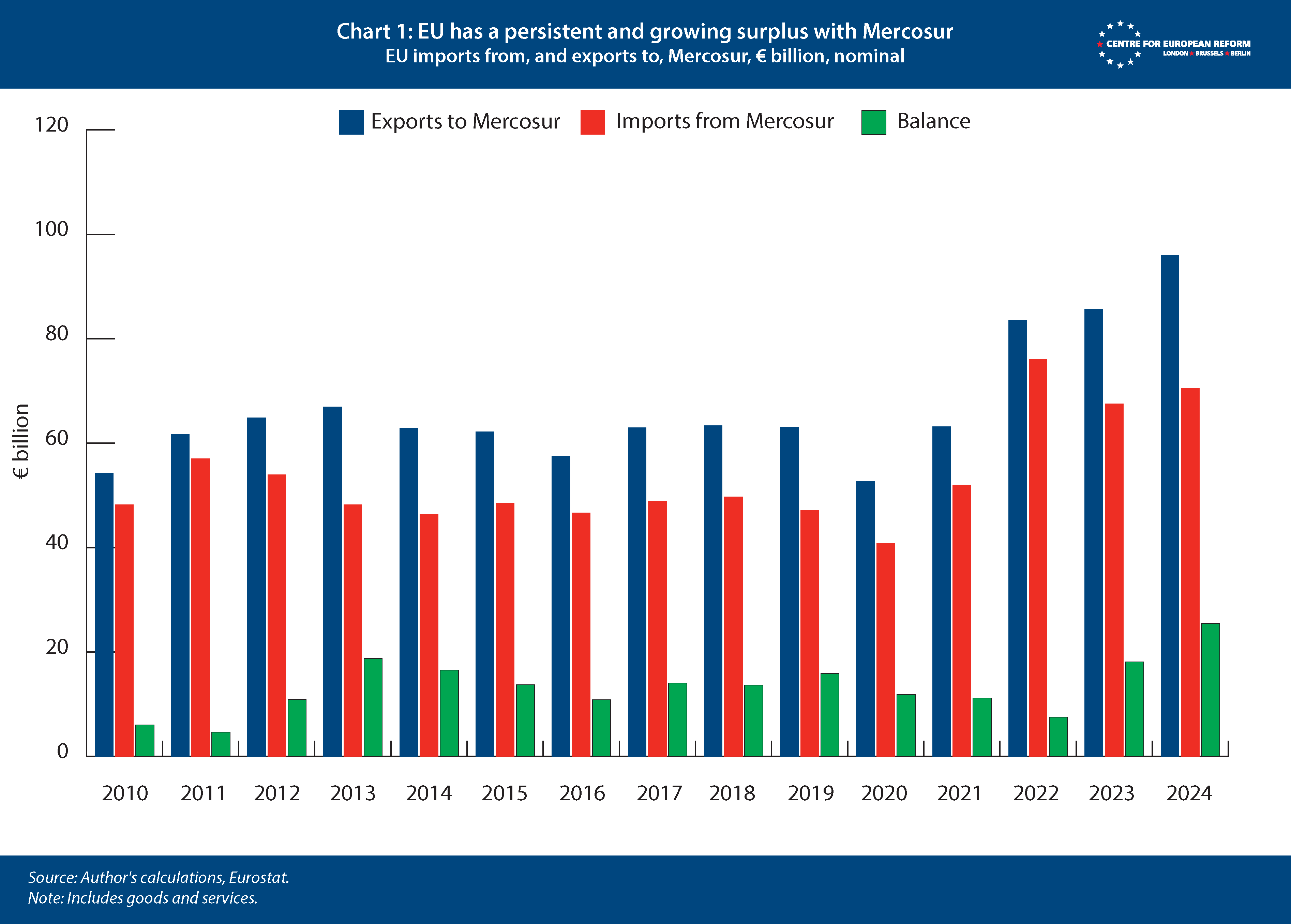
Measured by macroeconomic stakes, the political controversy around the Mercosur agreement is disproportionate. Trade with Mercosur benefits mostly EU countries, since the EU has a persistent and growing surplus with the four South American countries (chart 1).
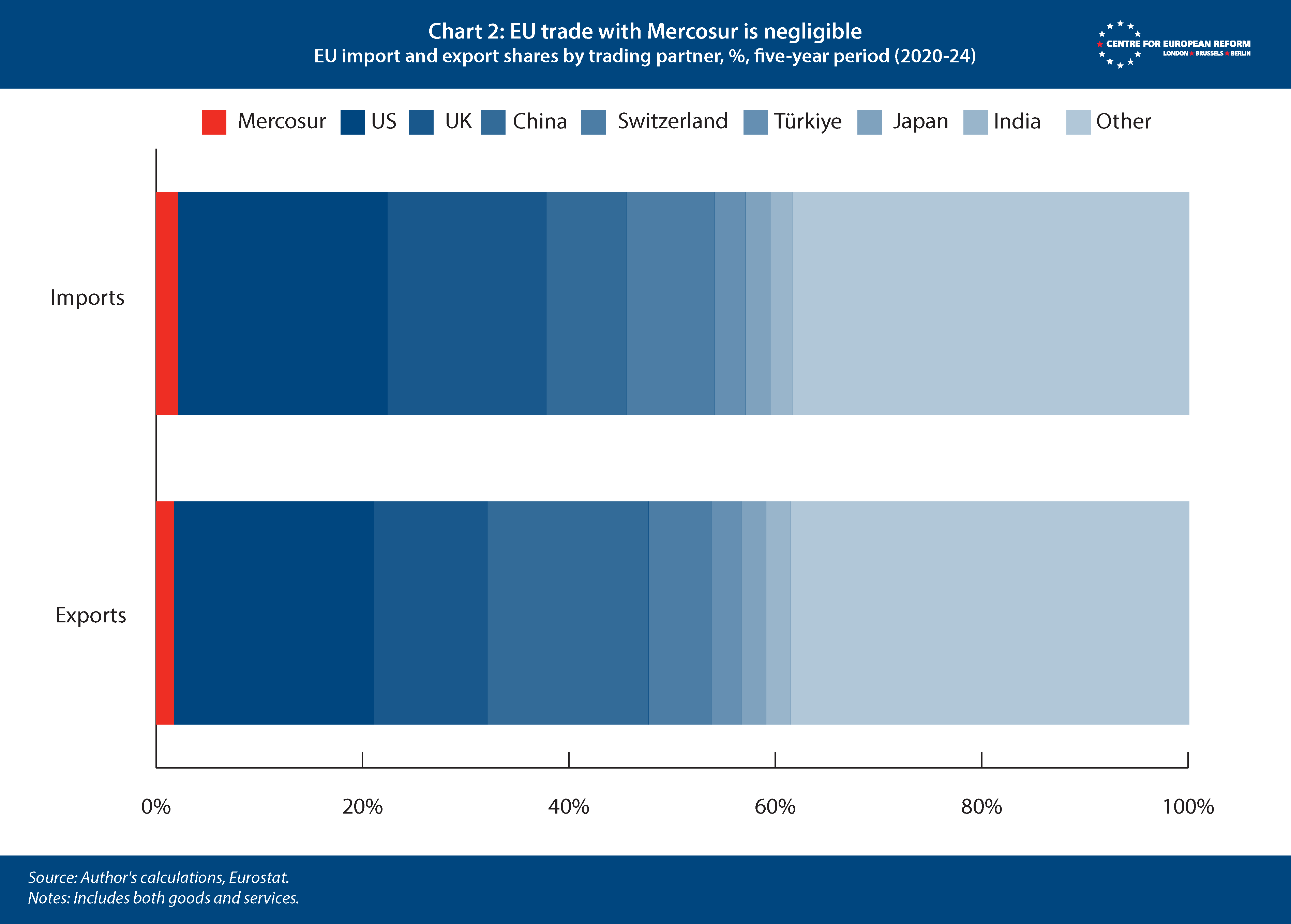
At the same time, Mercosur is a modest trading partner for the EU. Exports of goods and services to the four countries account for about 2.1 per cent of total EU exports (chart 2) – roughly half the level of EU exports to Turkey. Imports from Mercosur are around 1.7 per cent of all EU imports – small compared with those from the US (19.4 per cent) or China (15.6 per cent). The mismatch between modest economics and intense political debate reflects a familiar feature of trade politics: benefits are broad and dispersed, while costs are concentrated and politically exploitable by opponents. Where institutions provide multiple areas to contest and delay, organised interests will use them. Europe’s system provides many.
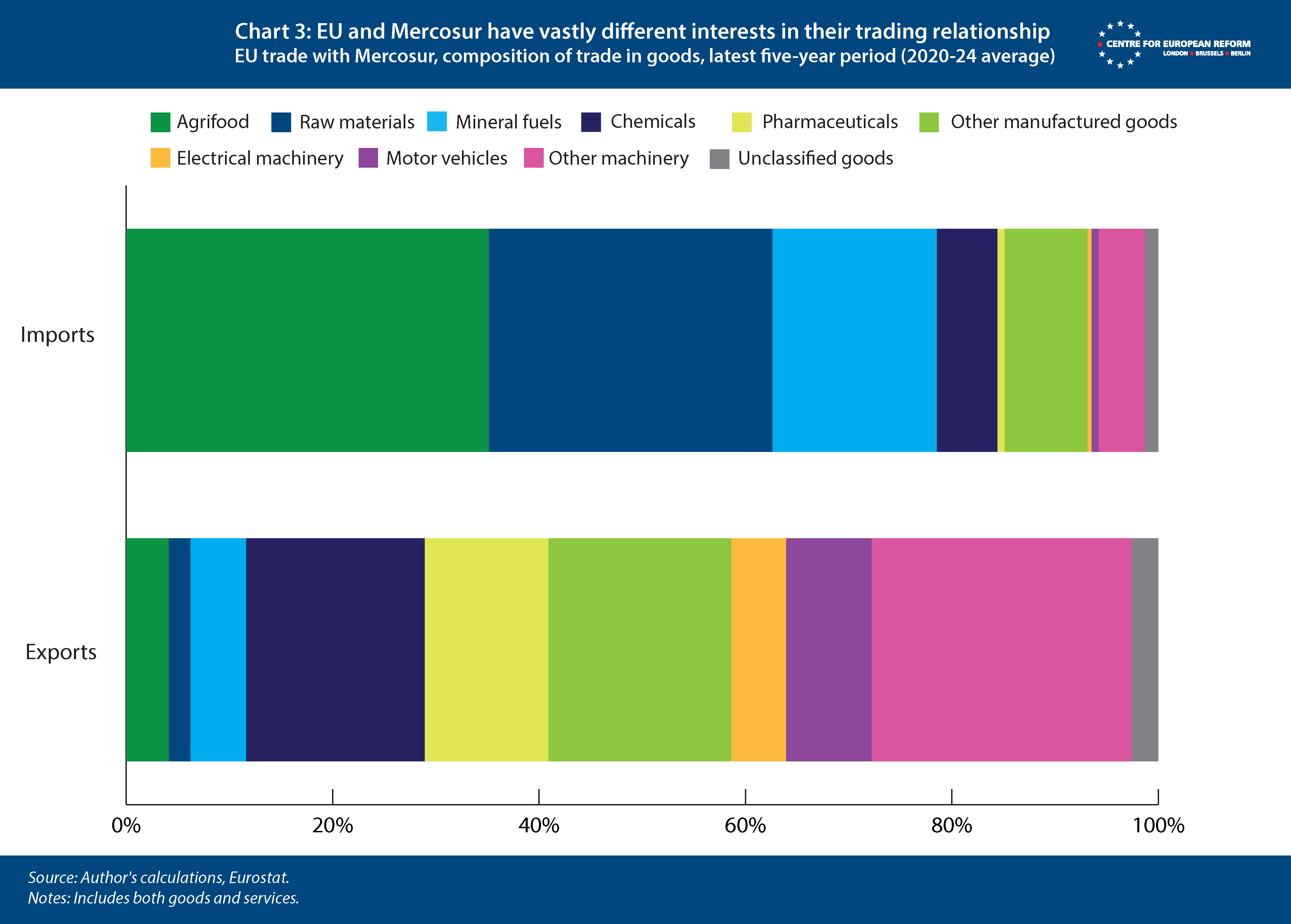
In substance, the Mercosur agreement is conventional. Claims that it creates a “free-trade area of 700 million consumers” overstate what it delivers. The agreement reduces tariffs on most industrial goods but does not eliminate them all; it expands quota-based access for sensitive agrifood products (often after phase-in periods) but does not open EU agricultural markets without limits; and it does little on behind-the-border regulatory barriers and makes little progress in the areas where trade negotiations are hardest: services and investment. The resulting bargain is clear and reflects each side’s distinct interests in this trading relationship (chart 3): easier market access for EU firms in sectors where Mercosur protection has historically been high – autos, machinery, chemicals and pharmaceuticals – while South American agrifood producers gain expanded access for agrifood exports into the EU.
The deal goes a long way to assuage the fiercest criticism from European agricultural interests: cheaper imports will undercut European producers. But the market opening will largely be managed through tariff-rate quotas. Beef imports, for example, face a lower 7.5 per cent tariff but only within a quota of 99,000 tonnes, phased in over five years – around 1 per cent of the EU’s annual beef consumption. The agreement includes safeguards for import surges and strengthens protections for European geographical indications, benefitting EU agrifood exporters. And the broader political reality is unchanged: farming remains heavily supported and politically protected within the EU. The Commission’s attempt to ease opposition by earmarking an additional €45 billion in future support to farmers from the next EU budget only underlines that politics.
Environmental criticisms are harder to dismiss. Mercosur countries have weaker environmental standards than those in Europe, and the agreement’s climate and sustainability provisions are viewed as weaker than what the EU’s rhetoric implies, with key commitments unenforceable under the agreement’s dispute settlement. But this is not a Mercosur-specific defect. It reflects a perennial weak spot in EU trade policy: the Commission increasingly wants trade to serve broader environmental, climate and labour aims, but prefers to pursue those aims through unilateral instruments – carbon border measures or domestic regulations that condition access to the EU market – rather than binding enforcement in trade treaties. Europe wants to export values, but it is reluctant to litigate them through its trade agreements.
Environmental criticisms are hard to dismiss. Mercosur countries have weaker environmental standards than those in Europe.
If there is a substantive weakness in this agreement, it lies in the limited opening for services. Services are where the EU typically has offensive interests, even though FTAs are notoriously poor at unlocking meaningful market access. Aside from modest procurement provisions, the agreement leaves services trade largely untouched. That is a missed opportunity. The South American market is comparatively accessible for European services providers, with fewer linguistic and cultural barriers compared with many Asian markets. That this barely features in political debates is telling: what matters most economically is not what mobilises politically. Services exports are too dispersed and diverse to lobby effectively; farmers are not.
Tensions between geoeconomic ambition and delivery
For the European Commission, the significance of the Mercosur agreement goes beyond market access. Officials present it as part of a broader push to use EU free-trade agreements as instruments of resilience and 'geopolitical hedging' – diversifying trade and reducing exposure to concentrated dependencies. But at the same time, the ongoing difficulty of assembling a domestic political coalition for the agreement has exposed some uncomfortable tensions in the EU’s capacity to translate its geoeconomic ambitions into delivery.
The first is that internal ratification difficulties are starting to weigh on the EU’s credibility as an external partner. The EU remains an attractive counterpart, and the Commission has become better at closing trade negotiations – recently with India, Indonesia and Mexico. But when each agreement triggers the same pattern of domestic contestation – organised opposition, intra-EU bargaining, and political leaders sheltering behind procedure – partners will increasingly draw a conclusion: the EU can negotiate and promise, but it may not deliver. Credibility is earned not only through negotiating agreements, but by getting them over the line.
The second is that geopolitics has done little to alter the political economy of trade within the EU. The Commission’s ‘geoeconomic’ framing assumes that strategic necessity will discipline domestic politics. Most European leaders are committed to openness and rules-based trade in their rhetoric, but they revert to obstruction when costs show up at home. The distributional politics of trade remains the same: gains are diffuse and long-term; costs are concentrated and politically salient. The EU’s structure amplifies this problem: agreements negotiated in Brussels must survive multiple domestic political arenas, each with its own veto players, and strong incentives to free-ride on others’ political courage. This is not a one-off, but rather a structural feature of European trade policy that persists even when strategic arguments are meant to carry the day.
Finally, Europe’s geoeconomic strategy is increasingly pulled into institutional power-politics in Brussels. The struggle over Mercosur is not only about beef quotas or sustainability clauses; it is also a strained Commission-Parliament relationship. Many MEPs – not only in the political extremes but also within the governing coalition – are frustrated with the second von der Leyen Commission’s approach to engaging with Parliament. When opportunities arise to assert leverage, they take them, turning important votes into proxy battles over institutional authority. That makes the EU’s external strategy vulnerable to internal score-settling.
Europe’s geoeconomic strategy is increasingly pulled into institutional power-politics in Brussels.
None of this bodes well for the EU’s geoeconomic ambitions. The EU wants to behave like a unitary power abroad – using trade to diversify, build resilience and project influence. Yet it remains, at home, a fragmented entity: it can negotiate from the centre, yet it struggles to mobilise the political consent required for what it signs. Unless the EU finds a better way to align its domestic political and institutional incentives in line with its external aims, its ambitions will continue to outrun its capacity to deliver. Von der Leyen’s ‘powerful message to the world’ will still echo through speeches drafted in the Berlaymont. It will just keep getting lost on the way out.
Anton Spisak is a senior research fellow at the Centre for European Reform.
Add new comment