
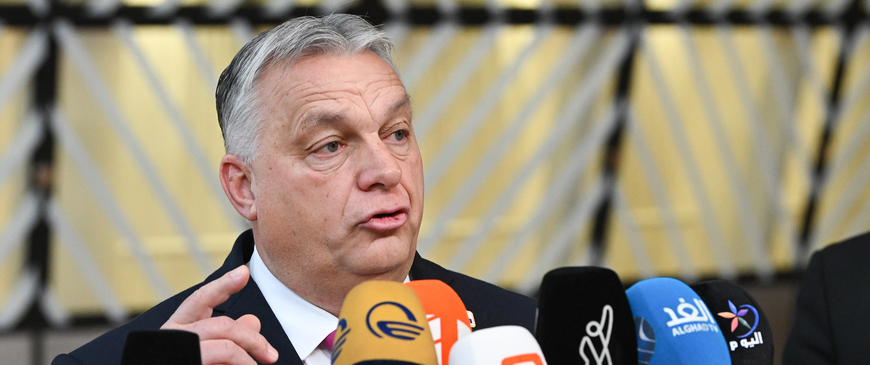
Could Viktor Orbán Lose in April?
Before Donald Trump arrived on the scene in the United States, Viktor Orbán’s Hungary had already heralded the rise of populist illiberalism and the new far right. That is why all who seek to prevent or escape strongman rule will be watching the upcoming parliamentary election closely.
Over the past decade and a half, Hungarian Prime Minister Viktor Orbán has established himself as Europe’s strongman par excellence. But strongmen are not immune to politics, economic downturns, or shifts in international relations. With all three of these now in flux, Orbán’s grip on power is slipping ahead of the country’s parliamentary election on April 12.
If his Fidesz party loses, the implications will extend well beyond Hungary, which has long been a bellwether for international political trends. Before Donald Trump arrived on the scene in the United States, Orbán’s Hungary had already heralded the rise of populist illiberalism and the new far right. All who seek to prevent or escape strongman rule will be watching this election closely.
Hungary’s campaign season has already offered useful lessons. The first is that even in an “electoral autocracy” like Hungary, traditional politics still matters. Political prowess and grassroots mobilization can shake things up and challenge the illusion of invincibility. Orbán’s charisma andpolitical talent have helped make him one of Europe’s longest-serving leaders. But charismaticleaders are vulnerable to equally charismatic challengers, and that is what Orbán faces in Péter Magyar.
A former Fidesz member, Magyar has upended Hungarian politics as the leader of the opposition Tisza (Respect and Freedom) party. He is playing Orbán at his own game, and that means that Orbán’s political brand – brave freedom fighter boldly defending European values – may be progressively demystified.
Magyar has only a fraction of Orbán’s experience, yet he operates like a seasoned political professional. He has put a spotlight on Orbán’s poor governance, including the dismal state of infrastructure and the health-care and education sectors – areas that have been neglected because ofthe incumbent’s undue focus on culture wars and foreign policy. He has also campaigned with remarkable discipline, building an active and enthusiastic voter base through hundreds of face-to-face interactions.
The rise of a capable challenger is only half the story, though. A second lesson is that not evendeeply entrenched strongmen can ignore the economy. Before COVID-19, Hungary’s annual GDPgrowth averaged 3.6% (owing to a steady drip of European Union cohesion funds), allowing Orbánto claim that living standards had risen consistently under his watch. But since the pandemic, growthhas practically fl atlined, amounting to a measly 0.4% in 2025 – well below the EU average, not tomention the government’s original target of 3.4%.
Predictably, Orbán has doubled down on fear mongering, claiming that a Magyar-led government would send Hungarians and their money off to the war in Ukraine. But the economy remains the decisive issue. Hungary’s working class and the thin middle-class cohort that has traditionally supported Fidesz for practical reasons have been hit particularly hard. Consumer prices have risen faster in Hungary than in any other EU country – by 66% between 2015 and 2024. Even the most charismatic of leaders would struggle to keep voters content under such conditions.
A final lesson concerns the international context in which Hungary’s election campaign is unfolding. European leaders – weary of Russia’s war in Ukraine and spooked by Trump’s intervention in Venezuela and designs on Greenland – are scrambling to develop a new strategic posture and bolster their military capabilities and security infrastructure. But the European far right is also pursuing its own alliances, and the new US National Security Strategy (NSS) leaves little doubt about whom the Trump administration supports.
Thus, while campaign dynamics and the state of the economy may favor Magyar, broader geopolitical conditions could benefit Orbán, a shamelessly loyal Trump cheerleader. But Trump’sreturn to power hasn’t done much for Orbán. Like the rest of the EU, Hungary has been hit byTrump’s tariffs and the resulting uncertainty. Moreover, Trump has not bothered to revive a US-Hungary double-taxation treaty that was terminated by the Biden administration, and the $20 billionUS credit line that Orbán thought he had secured during a visit to the White House last year appearsto have been lost in translation.
Of course, despite the lack of benefi ts for Hungary, Trump may yet deliver for Orbán personally. The new NSS lists Hungary among those countries that MAGA hopes to peel away from the EU, implying that there could be not just Russian but also American interference in the upcoming election. Still, any support from Trump is unlikely to come with no strings attached. Orbán has already promised to buy US energy, including small modular nuclear reactors worth up to $20billion.
For now, Magyar and his party are in the pole position, buoyed by a heady combination of anger and hope. But strongmen will stop at nothing to hold on to power, and Orbán is certain to have more tricks up his sleeve. From toying with the idea of “castling” – installing a puppet head of state, à la Vladimir Putin when he inserted Dmitri Medvedev into the Kremlin for one term back in 2008 – to “flooding the zone” with AI-generated disinformation, Orbán has many tools with which to keep theplaying field tilted in his favor.
Whatever the outcome, Hungary’s election will be watched closely. If Magyar prevails, his playbookwill offer a model for others.