
Ukraine's EU accession process: Will Kyiv ever be "one of us"?
Although the EU and Ukraine have opened accession negotiations, full membership is still far away. Ukraine and the EU must implement necessary reforms, while the EU must find a quicker way to respond to the geopolitical imperative of keeping Ukraine in its camp.
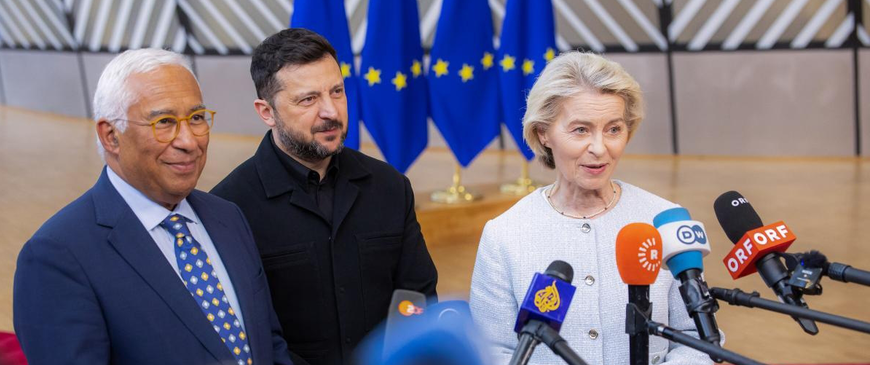
Days after Russia’s full-scale invasion of Ukraine began in February 2022, European Commission president Ursula von der Leyen proclaimed “Ukraine is one of us, and we want them in”. More than four years later, detailed accession negotiations have begun, but Ukraine is far from being ready for membership, and the EU is far from ready to let it in. Without watering down the requirements for full membership for Ukraine, the EU needs to come up with something better for Kyiv than the current offer for candidate countries.
On June 15th 2026 Ukraine and the EU finally launched formal negotiations on the first of the six ‘clusters’ that make up the acquis communautaire – the body of EU laws and rules with which candidate countries must comply before they can join the Union. The ‘fundamentals cluster’ – always the first cluster to be addressed with candidate countries, and the last to be finalised – deals with the rule of law, democratic institutions and good governance. Opening it is an important step. Ukraine must still overcome many obstacles before joining the EU, however.
Unrealistic expectations
First, Kyiv must accept that the EU is not going to short-circuit the accession process for any country. Ukrainian president Volodymyr Zelenskyy will have to give up the idea that Ukraine has already paid for EU membership in blood, and should receive it as soon as possible. The Commission and some member-states are irritated that he continues to raise unrealistic expectations that Ukraine may be able to join the EU in 2027.
Kyiv must accept that the EU is not going to short-circuit the accession process for any country.
Like any other candidate, Ukraine will have to show how it will comply with the acquis, or ask for transitional arrangements allowing it to delay full application of some rules temporarily. Zelenskyy therefore needs to focus the attention of Ukraine’s institutions on the slow grind of passing the legislation and implementing the reforms needed for Ukraine to fulfil the obligations of a member-state.
In April 2026 the government adopted the National Programme for the Adoption of the Acquis (NPAA), which sets out in detail what Ukraine needs to do to align its legislation with EU rules. The Commission has a positive view of the NPAA. Its implementation, however, depends on Ukraine’s parliament, the Verkhovna Rada. Speaking privately, an EU official recently complained that the Rada had not passed a single piece of legislation that mattered to the EU between November 2025 and April 2026; it is not yet clear whether the NPAA will inject more urgency.
The Rada is increasingly dysfunctional, as are its relationships with the president and the government. On paper, Zelenskyy’s ‘Servant of the People’ party still has the votes it needs to pass legislation, including that required by the EU, but in practice it has to rely on other parties to reach a majority. Members of the Rada complain, however, that Zelenskyy will not work with the pro-European opposition – which, combined with Servant of the People’s votes, would give him a comfortable majority for EU-related legislation.
The opposition is also unhappy with the quality of some of the draft legislation the government puts forward. In addition, Rada members and domestic and foreign observers in Kyiv suggest that parts of Zelenskyy’s administration and various other stakeholders with vested interests surreptitiously use sympathetic MPs and Rada procedures to introduce wrecking amendments that water down or frustrate the reforms demanded by the EU, including on combating corruption.
Bilateral disputes and vested interests
The second obstacle to Ukrainian membership is the need to secure the unanimous agreement of the existing members. Ukraine’s relations with some of its neighbours are dogged by historical disputes and ethnic tensions. Some member-states also see Ukrainian accession as a threat to their economic interests.
The opening of Ukraine’s accession negotiations only became possible once Hungary’s prime minister Viktor Orbán had lost power in April 2026; but his successor, Péter Magyar, is still blocking the Commission’s effort to open negotiations on the remaining five clusters of the acquis by the end of July. Like Orbán, he wants special treatment for Ukraine’s ethnic Hungarians, though he is pursuing his aim less aggressively.
Zelenskyy has also sparked a needless row with Poland by naming a Ukrainian army unit after a partisan force that fought for Ukrainian independence from the Soviet Union during World War Two, but was also responsible in 1943-45 for the murder of perhaps 100,000 Poles in areas that had been part of Poland between the First and Second World Wars. Poland’s right-wing nationalist president, Karol Nawrocki, has responded to Zelenskyy’s action by rescinding the award of Poland’s highest state honour to him. The Polish prime minister, Donald Tusk, has been reminding everyone that the dispute only benefits Russia. Zelenskyy and Nawrocki met in the margins of the NATO Summit in Ankara on July 8th; while they did not resolve their dispute over history, they did at least agree to continue the dialogue. But if Zelenskyy wants to join the EU, he will probably have to make some conciliatory gestures to his neighbours, whether or not he thinks they are justified.
Apart from issues of history, Ukraine’s comparative advantages in some economic sectors also threaten vested interests in a number of member-states. Before the war, Ukraine was an agricultural powerhouse. According to the UN Food and Agriculture Organization, in 2021 it was the world’s largest producer of sunflower seeds and the largest exporter of sunflower oil; the third largest producer of potatoes; and the seventh largest producer and fourth largest exporter of wheat. Though the war has reduced production and exports, if Ukraine’s large, vertically integrated agricultural producers could sell into the EU market without restriction they would undercut farmers in countries including Poland and France.
A foretaste of the tension this could cause came when the Commission gave Ukraine tariff- and quota-free access to the EU market in June 2022; this prompted demonstrations by Polish and other farmers against unfair Ukrainian competition, leading the Commission to reimpose tariffs and quotas in June 2025. Polish truckers have also repeatedly blocked border crossings with Ukraine since 2023 to protest about competition from Ukraine’s large road haulage industry.
Too unwieldy a Union
The third obstacle is that many member-states think that the EU needs internal reforms before it can expand again.
Some member-states worry that a Union of more than 30 states would be paralysed by vetoes, since some key areas of decision-making – including foreign policy, taxation and the EU budget – demand unanimity. Changing decision-making arrangements in foreign policy from unanimity to qualified majority voting is foreseen in the EU treaties, but requires unanimous agreement; in other policy areas changes might need treaty amendments, which would trigger hard-to-win referendums in member-states such as Ireland.
Many member-states also think enlargement is impossible without budgetary reform. Even before Ukraine became a candidate country, member-states worried about how poor the candidate countries were by comparison with even the poorest of the current members. With smaller candidate countries such as Montenegro (population: 630,000; GDP per capita on a purchasing power parity (PPP) basis: about half of the EU average) such disparities might be accommodated. But it would take vast resources to enable Ukraine – with a pre-war population of more than 40 million and a current GDP per capita, on a PPP basis, of less than one-third of the EU average – to recover from the war and converge economically with the rest of the EU.
As Elisabetta Cornago explained in a 2025 CER insight, the accession of Ukraine and other current candidate countries would not lead to an unsustainable increase in EU spending, though some countries would definitely see reduced receipts from EU programmes. But Ukraine’s accession ought to precipitate some long-needed reforms of cohesion spending (designed to narrow the gaps between richer and poorer areas in the EU) and the common agricultural policy (CAP). Reforms could mitigate the financial impacts of enlargement on the existing member-states that are the main beneficiaries of cohesion funding and the CAP today.
How to bridge the gap to membership?
For all von der Leyen’s talk in 2019 about establishing a geopolitical Commission, the EU remains a community of laws and the accession process remains merit-based. However much the EU wants Ukraine to join and however hard Ukraine works on alignment with the EU, it will be impossible for it to take all the necessary legal and regulatory steps, establish the necessary institutions, show a record of implementation of the acquis, and persuade all the member-states that they should ratify its accession to allow it to join as a full member even by 2030. It is easy to see a scenario in which Ukraine becomes stuck in limbo, as Türkiye has – still a candidate country, on paper, but with very little prospect of joining the EU.
Ukraine is not Türkiye, however. It has become the keystone in Europe’s defence against an aggressively expansionist Russia. It is in Europe’s vital interest to ensure that Ukraine prevails in the conflict, and emerges from it as a stable and prosperous democracy. Ukrainian disillusionment with Europe risks increasing if inadequate military support allows the war to drag on, while the EU accession process stalls. It would be easy for Russia to manipulate public opinion, not necessarily to make Ukraine more pro-Russian, but to make it more resentful and more divided on where its future lies. A Ukraine left in limbo between an unwelcoming EU and a hostile Russia – with uncertain borders, unresolved disputes with some of its Western neighbours, and traumatised and in many cases armed people struggling to rebuild their ruined country – would destabilise the rest of Europe.
Ukraine has become the keystone in Europe’s defence against an aggressively expansionist Russia.
Both Brussels and Kyiv have a responsibility to their own populations and to European security to work on preparing Ukraine for membership as quickly as they can, but that will still take time. Meanwhile, the EU must find something more for Ukraine (and for the long-time candidate countries in the Western Balkans, which should not be left behind) than the standard accession process. That offers the candidates no guarantee of eventual membership, but obliges them to carry out EU-required reforms or risk the prospect of membership being taken away.
The EU and several member-states have put forward a few options to integrate Ukraine into areas of EU activity without offering it full membership, in particular:
Reverse accession. Proposed by the Commission early in 2026, reverse accession would involve giving Ukraine EU membership before it had met the criteria, and then progressively admitting it to programmes and policy areas once it could fulfil their requirements. The idea did not go down well with the member-states, which saw it as too much of a departure from the merit-based approach.
Associate membership. Proposed by German chancellor Friedrich Merz in May 2026, associate membership status would give Ukraine a non-voting European commissioner, non-voting MEPs, an observer judge at the Court of Justice of the EU, and a political commitment from existing member-states to apply Article 42.7 of the Treaty on European Union, the EU’s mutual defence guarantee, to Ukraine. This was rejectedby Zelenskyy as “unfair”.
Both EU opponents of reverse accession and Ukrainian critics of associate membership should think again about the proposals; and the Commission should consider whether there is a way to combine elements of both. Inviting Ukrainian and other candidate countries to appoint representatives to EU bodies with the right to speak but not vote, and to nominate ‘shadow’ commissioners on a similar basis, would in practice enable them to influence EU policy (but not decide it). It would also allow them to build up their ability to operate within an EU framework, ensuring that they would be better prepared for eventual membership. As candidates fulfilled the requirements of the acquis in each policy area, such as energy, agriculture or transport, they could be treated more like member-states.
The EU must find something more for Ukraine than the standard accession process.
The new arrangements would have to be accompanied by an information campaign aimed at making existing member-states comfortable with the implications of the candidates participating in an increasing share of EU activities.
At present much of the narrative around enlargement focuses on the costs of admitting new members – as has been the case before previous rounds of enlargement. As IMF research has shown, however, the 2004 ‘big bang’ enlargement, which also brought in a lot of relatively poor countries, increased GDP per capita in the ‘old’ member-states by around 10 per cent; there is no reason why expanding the single market to Ukraine and other candidates should not have a similarly positive effect.
The Commission and the member-states championing enlargement should be more confident in stressing the wider benefits to European security and prosperity of an enlarged EU. Even with such a campaign, it may be difficult to get the unanimous agreement of existing member-states to take in some or all of the candidates; without it, it will certainly be impossible.
Homework for Kyiv and Brussels
Gradual integration, whether through associate membership or some other model, would only provide Ukraine with a secure route to membership if it also did its homework conscientiously. Ukraine cannot simply rely on the strong moral case for letting it into the EU, based on the amount of blood it has shed in defence of European values, without also showing that it is ready to act like a normal EU member-state. The private message from European leaders to Zelenskyy should be that he must shift his focus from demanding accelerated accession regardless of the state of reform in Ukraine to driving forward accelerated reforms as the route to inevitable EU accession, but with no deadline attached. In parallel, the Commission and the member-states should also step up their existing technical assistance to Ukraine and other candidates, for example by posting more officials into ministries and other institutions, including at regional and local levels, in the kind of ‘twinning’ programme that helped the 2004 cohort of new member-states get up to speed quickly.
Meanwhile, the EU must also do its own homework. If member-states sincerely believe that internal reform must precede enlargement – rather than using the absence of reform as a pretext to delay enlargement indefinitely – they need to agree on what reforms are needed, implement them and, in countries where treaty changes have to be endorsed in referendums, argue the case for them.
The EU and the member-states must rise above narrower concerns about historical disputes, or increased competition from Ukrainian farmers or hauliers, and see the importance of anchoring Ukraine in a democratic Europe. Ukraine now has Europe’s most powerful and best trained armed forces, with the benefit of a scaled up, innovative defence industrial ecosystem that the rest of Europe can only hope to emulate, and its forces stand between the EU and an increasingly aggressive and expansionist Russia.
Even if Ukraine and the EU carry out every reform needed to make a success of Ukraine’s EU membership, there will still be practical problems caused by the war to solve, such as the absence of a defined line of control between Russian and Ukrainian forces. If the EU insists that membership is impossible until the front line is fixed, it gives Russia an incentive to keep it moving, in order to delay Ukraine’s accession. So the EU needs to find creative solutions based on Ukraine’s de facto control of territory.
But whatever the practical issues, if the Ukrainian government and the Rada do everything needed to align with the acquis, the promised EU membership should not be delayed. Ukraine will not be ready to join the EU in 2027, but it is in the EU’s interests that Europe’s largest country should indeed be “one of us” as soon as possible.
Ian Bond is deputy director of the Centre for European Reform.
The author is grateful to a number of European and Ukrainian officials and civil society representatives who spoke to him on a background basis during visits to Kyiv and Brussels. The views expressed here are his alone.
Add new comment