
How the EU can rescue its battery industry
The EU risks becoming totally dependent on China for batteries. It can avoid this outcome through supporting its existing battery manufacturers, collaborating with trusted middle powers and investing in next-generation storage technologies.
Batteries are an essential part of our energy system today – powering homes, industries and transportation. Many EU battery manufacturing projects have failed, however, despite EU support for the sector. China now accounts for more than 80 per cent of the world’s output of battery cells. It is the dominant manufacturer of most mature battery technologies. Europe needs to act urgently if it wants to retain a foothold in the global battery market
The EU must balance several policy goals at the same time: retaining access to affordable batteries to accelerate the energy transition; reducing dependency on Chinese battery cells; and developing a domestic battery sector that can compete and therefore support Europe’s economic growth.
Batteries: A critical technology
Improvements in performance and rapid cost reductions have made batteries – once thought to be of only marginal use at best – a key technology for balancing the variable output of solar and wind power. In 2025, Europe installed 36 gigawatt-hour (GWh) of stationary batteries, an increase of 48 per cent compared to a year earlier. To put that into perspective, if all the batteries installed in the EU in this period were fully charged and discharged at once, they could supply all of Lithuania’s total daily electricity needs. This is in addition to approximately 200 GWh worth of batteries installed in newly registered cars and trucks.
As electrification has become important for the wider economy, battery manufacturing has acquired a more strategically significant role. China recognised this as early as the late 1990s, both in relation to electricity storage and as a key component of electric vehicles. More than two decades of focused industrial policy have enabled China to scale up production and become a leading manufacturer across a range of battery technologies.
As electrification has become important for the wider economy, battery manufacturing has acquired a more strategically significant role.
The EU has also recognised the strategic importance of batteries. The EU and its member-states have supported battery manufacturing through R&D funding (Horizon Europe’s Batt4EU partnership); relaxed state aid rules for two battery projects worth over €6 billion; provided Innovation Fund grants for cell factories; and made EIB loans to battery manufacturers. In December 2025, the Commission announced the Battery Booster, a €1.8 billion package that included €1.5 billion in interest-free loans for battery cell producers.
Made in EU: Ambition meets reality
While EU initiatives have brought together hundreds of industry actors and mobilised billions in capital, the sector has suffered from intense price competition from China, leading to many stalled or cancelled projects. As the European economy recovered from the Covid-19 pandemic, European battery manufacturers enthusiastically announced large new factories, particularly in 2022. Volkswagen alone planned to develop 240 GWh of battery factories in Europe, enough to supply battery packs for over 3 million cars.
Yet the sector soon hit a wall. Several European battery companies failed, with the collapse of Northvolt being the most prominent example. The Swedish company – and Europe’s best-funded battery start-up – had raised around €14 billion since 2016 before filing for bankruptcy in March 2025.
The sector faced a combination of high interest rates, global overcapacity and difficulties in scaling up production. Some European battery manufacturers struggled to move from pilot projects to commercially viable production. Others saw key customers pull back their orders, undermining the business case for expanding domestic manufacturing capacity. The slower-than-expected transition to electric vehicles (EVs) in Europe – compounded by pressures from the car sector to prolong the production of vehicles with internal combustion engines – added further uncertainty about future battery demand for EV manufacturing in Europe.
At the same time, China expanded battery production far beyond current demand, creating global overcapacity. For Chinese companies, the problem of over-production was managed through a series of government-led capacity restraints and selective support for battery manufacturers. For European producers, however, there was no such protection. As demand for their batteries declined, the utilisation rate of their factories and their profitability fell.
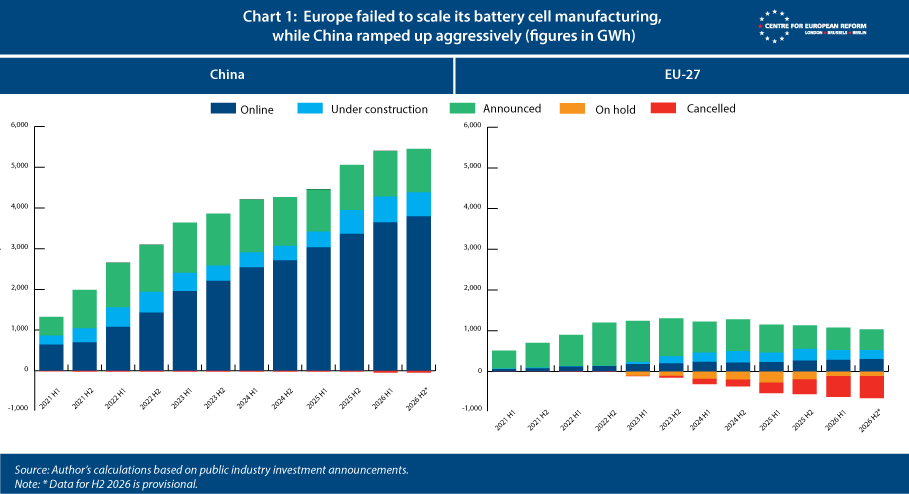
As a result, the European battery dream was shattered. Chart 1 shows the announcements and the relative flatlining of battery manufacturing capacity in Europe. Since 2024, 559 GWh worth of projects have been cancelled across Europe. Some projects have survived the onslaught, although most of them involved non-European producers with more experience of managing these types of factories, such as the Korean firm LG Energy Solution’s Wrocław plant in Poland, which is Europe’s largest battery factory. Europe’s battery sector now risks following the same trajectory as its solar panel manufacturers, which went from having 40 per cent of the global solar module manufacturing capacity in 2008 to being almost wiped out by cheaper Chinese competitors, possessing about one per cent of global production capacity in 2025. Europe is in danger of ceding another strategic sector to China – and one which is much more important to other sectors of the economy than the photovoltaic panel industry.
Can Europe recover?
Chinese manufacturing capacity – and the speed with which it continues to expand – make it unlikely that Europe, despite its ambitions to be a clean technology leader, will be able to build enough capacity to become a net exporter of the most produced battery types in the short-term. Chinese companies such as CATL and BYD each have more manufacturing capacity than the whole of the EU combined – with CATL alone holding roughly three times the capacity of the entire EU. Both companies produce good-quality batteries in such large amounts that they will likely dominate third markets, crowding out future battery exports from Europe. For the foreseeable future, Europe’s opportunity to export the most common battery types is exceedingly small.
Europe should not try to challenge the dominance of China in current types of battery technology. Rather, it should prioritise preserving a viable domestic manufacturing base that can meet some of its strategic needs. Domestic production matters for European security, not least because drones, military vehicles and grid storage depend on batteries. Once lost, the skills, suppliers and production know-how needed for next-generation battery technologies are hard to rebuild.
Domestic production matters for European security, not least because drones, military vehicles and grid storage depend on batteries.
Europe’s battery strategy should be based on three pillars: building a minimum level of strategic production reserve, deepening partnerships with other battery-producing middle powers, and pivoting to next-generation batteries.
Pillar 1: Build a minimum necessary strategic production reserve
Europe should maintain sufficient domestic battery manufacturing capacity to avoid becoming entirely reliant on China. Managing supply chain vulnerabilities through battery stockpiling would be expensive and difficult given the wide variety of battery types, standards and rapid technological change. Instead, the EU should build a strategic production reserve that would allow Europe to retain some of its production capacity for times of geopolitical turbulence.
The Net Zero Industry Act (NZIA) – an EU law passed in 2024 to support the bloc’s clean tech sector – set the objective of at least 550 GWh of battery production in Europe, which was initially expected to cover approximately 90 per cent of EU demand. Later estimates by the European Parliamentary Research Service (EPRS) and the Karlsruher Institut für Technologie (KIT) put EU demand for batteries in 2030 at 1000 GWh, which would mean the NZIA target would cover only 55 per cent of EU’s domestic needs.
The scale of potential demand is substantial. If the EU wants to produce all the batteries for its own car fleet domestically – 11.5 million cars are produced in Europe per annum, (let us assume they will all be EVs) – automotive demand alone would amount to approximately 690 GWh a year. The 550 GWh production capacity would not fully cover that demand, let alone stationary storage and e-trucks, which would increase the demand for battery capacity. To reach the NZIA 550 GWh benchmark, the EU would need an additional 265 GWh (see Chart 2).
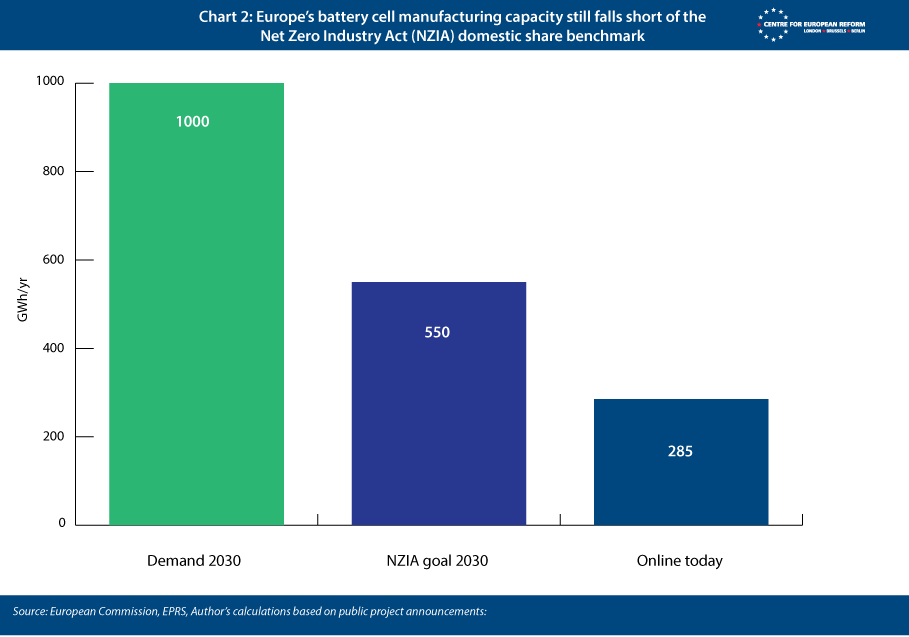
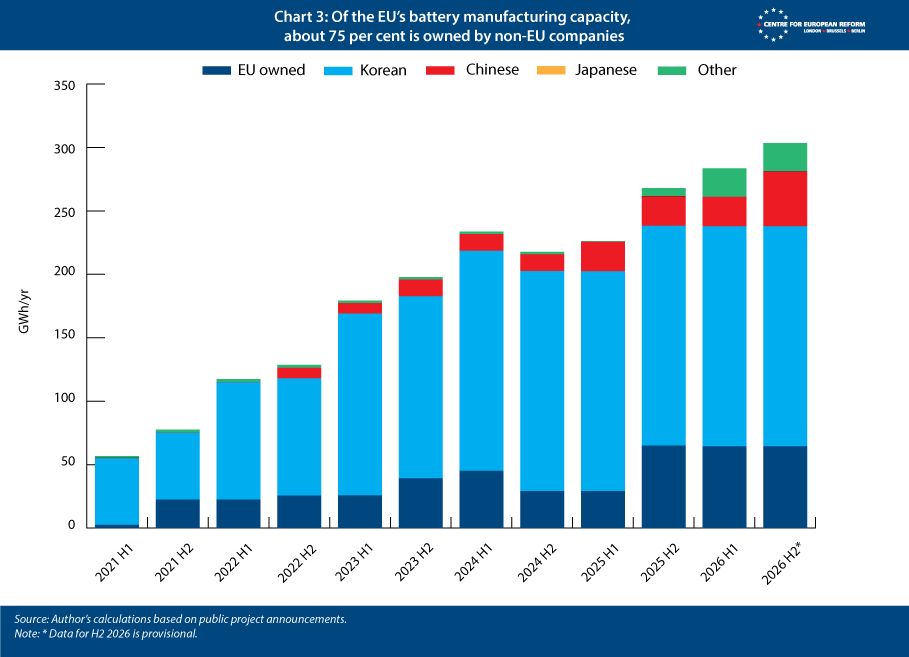
Of the current 285 GWh battery manufacturing capacity in the EU, a significant portion is foreign-owned. Ideally, the share of European-owned factories would increase to retain ownership over production assets. While foreign-owned production plants can support jobs, tax revenue and knowledge transfer, incidents like the Nexperia case show how fragile supply chains become when the owners of key facilities are established in hostile or potentially hostile countries. After the Dutch government took control of the Chinese-owned chipmaker in 2025, Beijing blocked chip exports from Nexperia’s Chinese plants, and European carmakers faced severe shortages.
The good news for the EU is that it does not have to start from scratch to hit the NZIA target. Current unfinished battery projects have enough potential to fill the remaining gap (see Table 1).Many of these projects are stalled or struggling, however. Completing them will require additional financial support.
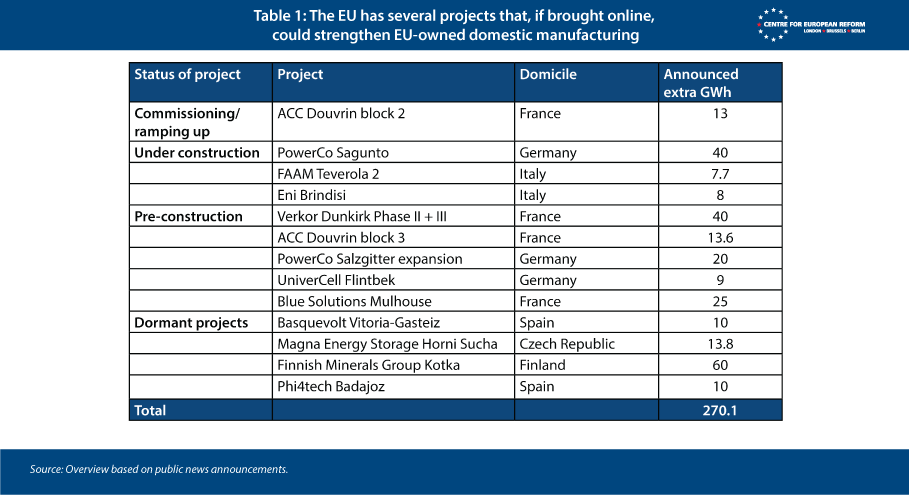
In the short term, policy-makers should make every effort to prevent pre-construction or dormant projects from being shelved entirely, as happened this year with plants planned by Norway’s Morrow Batteries and the innovative French battery manufacturer Tiamat. Without targeted policy support for battery manufacturers, most of these projects will probably remain unrealised.
There are two important levers that together unlock local battery manufacturing: procurement policies and production subsidies.
Firstly, the EU can create local demand for European batteries by including local content requirements in public procurement policies. The EU is considering such requirements as part of the Industrial Accelerator Act (IAA) currently under negotiation. The local content requirements should furthermore include EU partner countries such as the UK, Turkey and other countries with which the EU has Free Trade Agreements. Shutting out key partners of our public procurement policies will unnecessarily damage diplomatic relations with these countries.
The EU can create local demand for European batteries by including local content requirements in public procurement policies.
The second part of the approach to stimulate production in the EU is through production subsidies. Historically, the EU has not allowed this type of industrial support in its state aid framework. However, as more countries are using production subsidies (including India, the US, Canada, Australia, Korea and Japan), the EU risks falling behind if they do not support localised manufacturing. Ideally, production subsidies are temporary, which allow businesses to scale up in Europe until they have attained sufficient knowledge and economies of scale to be able to survive without subsidies.
Together, these two measures will shut out unfair competition while at the same time incentivising production within the EU without alienating its key trading partners. Not unimportantly, the subsidies will make European batteries more affordable, maintaining momentum in the energy transition.
Nevertheless, the EU seems to be heading in the wrong direction. The Automotive Package proposal, put forward by France and Germany, would not provide adequate support for the battery industry. Member-states should require stronger local content requirements for battery cells in the final text of the IAA.
Also, production subsidies are not yet allowed. The current EU Clean Industrial Deal State Aid Framework (CISAF) does not include production-based incentives. The European Commission should start allowing this, or the EU will risk being outcompeted not only by China, but also by partner countries that offer such incentives.
Pillar 2: Leverage middle power partnerships
The EU should not completely close its doors to foreign batteries and battery manufacturers. Economic alliances between the EU and middle powers can help to diversify battery imports. South Korea, Japan and India, in particular, could prove useful partners. South Korea already has a strong position in EU battery manufacturing, indeed (Chart 3). The expected EU demand for batteries – even if the EU would hit its NZIA benchmarks for local production – is such that part of it will have to be met by foreign suppliers. The ‘Made in EU’ requirements for batteries are only relevant for public procurement and subsidy programmes. Foreign firms should be allowed in the rest of the battery market.
Ideally, foreign companies would invest directly in the EU, creating jobs and supply chains. Direct imports should also be possible, however, provided that this still resulted in purchases from a more diverse range of trade partners than at present, thus reducing any third country’s leverage over the EU.
Pillar 3: New opportunities for a strategic edge
While Europe must maintain a presence in battery manufacturing using existing technologies, it should also invest in emerging battery technologies, in which it has a better chance of developing a competitive edge.
One promising area is long-duration storage. Most battery storage systems currently supply energy for several days rather than several hours, but these new systems could store energy for much longer periods. This would, in turn, help speed up the energy transition, as long-duration storage could reduce the need to back up intermittent power sources such as wind and solar with nuclear or gas-fired power plants. Long-duration batteries could also become an export product for European companies. Europe already has potential in this area, with firms like Ore Energy (the Netherlands), Kraftblock (Germany) and Polar Night (Finland) all developing new battery technologies. Markets for such batteries are still relatively underdeveloped, which means there is scope for Europe to gain a competitive advantage.
While Europe must maintain a presence in battery manufacturing using existing technologies, it should also invest in emerging battery technologies.
Another promising area is the development of batteries with a much higher energy density for niche applications. The energy density of a battery measures how much power it generates per unit of volume. Products for sectors such as defence often require high energy density batteries due to their power requirements (for example, ground vehicles or radars). Defence manufacturers also need secure supply chains, less likely to be disrupted in times of conflict or tension by supply chain problems outside the EU. Another area where the new generation of batteries could produce dramatic change is in aviation: lighter, more energy-dense batteries are key to sustaining longer flights powered by electricity in both the civilian and military domains.
EU member-states are investing heavily in their defence bases, and have a strong position in the aviation sector thanks to companies such as Airbus (full disclosure: a CER corporate member) and its suppliers. Where realistically possible, EU member-states should maximise the use of EU-made batteries in defence goods. Building capacity for secure and energy-dense batteries would strengthen both defence supply chains and economic security. Companies such as Saft (France), Theion (Germany) and Basquevolt (Spain) operate in the next-generation battery space.
Conclusion
The EU is right to identify batteries as a strategic technology, given how important they are to transport, defence and the energy system. But without a strategy, European manufacturers will fail to scale up production of next-generation battery technologies, just as they are struggling with current generation of batteries. The EU should map the emerging ecosystems for the new technologies, and provide adequate public support both for next-generation battery research and current projects through grants, loans, subsidies and clear ‘Made with EU’ procurement rules.
The trajectory of the European battery industry shows that new technologies are hard to scale due to intense international competition. China and the US are already moving forward, providing various forms of state support for promising companies and projects of their own. If the EU wants to maintain its autonomy in crucial areas like energy and defence, it can no longer rely on open markets and fair competition to produce its desired outcomes – they no longer exist. It will have to intervene more actively to achieve the outcomes it seeks. Failing to do so will inevitably result in the European battery industry following the solar industry into manufacturing oblivion.
Ron Stoop is a research fellow at the Centre for European Reform.
Related content

Add new comment