
How to revive Europe's stock market listings
- Europe faces a ‘scale-up gap’: while it produces many innovative startups, they struggle to grow across Europe and access capital as they enter the crucial growth phase. Europe’s competitiveness and sovereignty hinge on whether it can close this gap and grow companies at home.
- To do that, the continent needs strong public equity markets, which allow growing companies to access capital to finance their expansion.
- However, European public markets have struggled in the last decade. The number of new companies listing in Europe is well behind that of the United States and their value has dropped significantly. Several of Europe’s most promising companies have chosen to list in the US.
- Three weaknesses help explain the poor state of European equity markets:
- First, while Europe has plenty of savings, too little is invested in equities. Around €10 trillion of EU household wealth sits in low-risk, low-return bank deposits.
- Second, European equity markets are highly fragmented, with more than 30 stock exchanges splitting up liquidity.
- Third, the proportion of large European Initial Public Offerings (IPOs) is too small – reducing liquidity and deterring the kind of institutional capital that drives significant investment in the US.
- This matters for Europe: if the continent’s most successful companies list elsewhere, its stock markets will lose firms that can attract additional capital and raise the profile of European markets. European listings support economic sovereignty by helping firms grow into global competitors and providing companies with an alternative to foreign acquisitions and listings.
- Rather than relying on shortcuts such as lowering listing requirements or creating a single European exchange, the EU and member-states should focus on three areas:
- Putting savings to work. Pension reform and greater retail investment should shift more household wealth into equities. Deeper capital pools would improve valuations and liquidity, providing more funding for companies to scale.
- Reducing fragmentation to encourage the market-driven integration of stock markets across Europe, improving their liquidity and efficiency. This will then help attract and retain larger listings. Policy-makers should consider a new pan-European growth market for promising, young companies.
- Facilitating a stronger pipeline of firms ready to list in Europe. That means completing the single market to ensure companies grow in Europe, expanding late-stage growth capital and creating incentives for larger, higher-quality IPOs.
Europe’s ability to scale innovation depends on its access to risk capital. Closing Europe’s innovation gap with the US and China will be vital to Europe’s competitiveness. Innovative companies in Europe face major challenges as they enter the scale-up phase, including access to finance and barriers to cross-border growth. Europe’s bank-dominated financial system is poorly suited to fund high-potential but high-risk businesses, and firms with limited tangible assets.1 Venture capital (VC) funds are better placed to finance such firms with long-term capital and their expertise. However, Europe’s VC market is significantly smaller than that of the US, especially for late-stage funding: the number of EU-based funds raising more than €250 million is only one-tenth of the US's funds.2
One important reason for the weaker VC ecosystem in Europe is the underdeveloped exit environment. Exit options – whereby founders and investors sell their stake in the company – include Initial Public Offerings (IPOs), acquisitions and buyouts. The exit environment is crucial for VC funds to return capital to their investors and raise funds for subsequent investments. Among the different exit channels, VC-backed IPOs deserve particular attention as they generate substantially higher value compared to acquisitions and buyouts, and drive investment in VC, particularly for later-stage investments.3
European IPOs, in particular, matter because successful listings can deepen domestic equity markets, supporting higher valuations and lower financing costs for listed companies. Successful new listings can attract capital to an exchange, increasing market depth and liquidity.4 Deeper and more liquid markets in turn attract further investment and larger listings, creating a virtuous cycle. This can improve valuations of listed companies and reduce the cost of capital5, which enables listed firms to invest in R&D and expansion. A well-functioning domestic stock market is particularly important for smaller companies, for which listing abroad is often not a realistic alternative. Strong domestic stock markets can also have broader positive economic effects: evidence suggests that consumers treat stock-market performance as an indicator of broader economic conditions, influencing confidence and spending behaviour.6
European listings also support the larger goal of strengthening European sovereignty. By improving the investment ecosystem, listings can help Europe build growth companies, retain firms and maintain greater control over frontier technologies, thereby reducing strategic dependencies. Attractive opportunities to pursue an IPO in Europe also provide European companies with a viable alternative to being acquired – often by foreign investors – or listing overseas. Domestic listings may also help anchor firms’ economic activity in Europe: the European Investment Bank (EIB) finds that firms undergoing an IPO are more likely to establish a headquarters in the country where their stock exchange is located.7 If headquarters move abroad, relationships with banks and investors, and corporate networks can shift with them, potentially influencing where future investments are made and reducing value creation in the local corporate finance ecosystem. Relocating legal headquarters abroad does not mean that all activity leaves Europe – often jobs in R&D and engineering remain8 – but Europe should be concerned when strategic decision-making and core corporate functions increasingly leave the continent with companies listing abroad.
However, European stock markets have struggled over the last decade. Compared with the US, European stock markets are roughly one-third the size, by market value, and have seen a sharper drop in the number of listed companies. 2025 was also one of the weakest years for European IPOs since the 2009 financial crisis. This is not a cyclical problem: US equity markets have been much more dynamic than those in Europe since 2019.
There is no single fix for Europe’s IPO market. Europe needs more institutional and retail investment to provide the necessary demand; deeper and more integrated equity markets capable of supporting large listings; and a true single market that provides a pipeline of companies able to reach public markets at sufficient size. This paper sets out reforms across these three areas to create a virtuous cycle in which companies attract capital, deeper markets attract more listings, and successful exits fund the next generation of European firms.
Why European stock markets are falling behind
Status quo of European stock markets and IPOs
IPO activity is shaped by factors such as stock market size and liquidity, valuation prospects and the broader investment environment. To understand Europe’s IPO gap, it is useful to examine the structure of European equity markets.
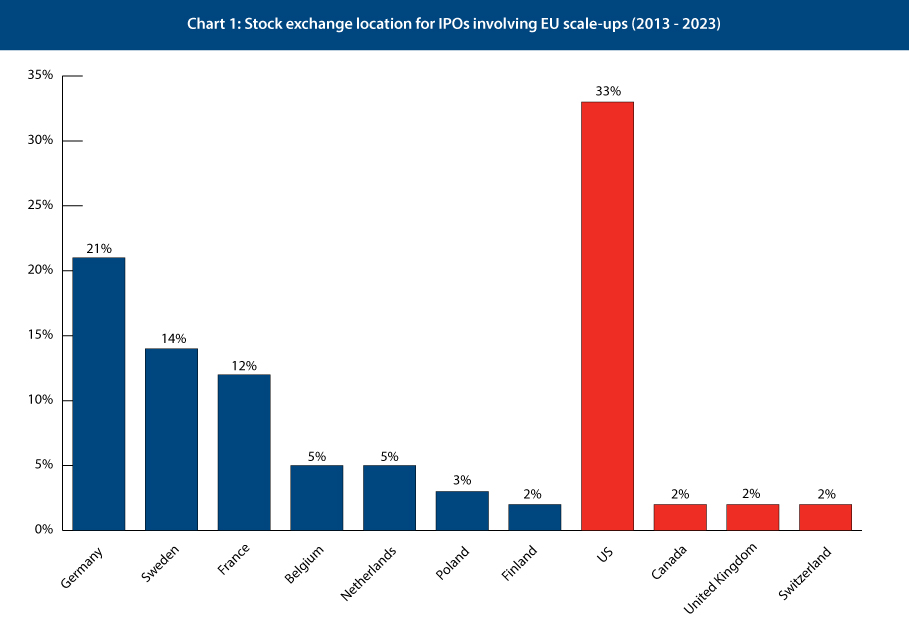
EU stock exchanges currently account for only 8 per cent of global IPO volumes, down from 32 per cent in 2015.9 European companies choosing an IPO in the US now generate 22 per cent of the total value of European IPOs. This figure has tripled since 2015. The shift in proportion is driven by a fall in the value of IPOs by European companies10, rather than an increase in the value of companies choosing an IPO in the US.11 Looking specifically at EU scale-ups, the US is the most frequent stock exchange location (see Chart 1).
Stock markets in the EU are smaller and appear less liquid compared to the US. Stock market capitalisation in the EU amounts to 55 per cent of EU GDP compared to 147 per cent in the US.13 Liquidity also appears lower: in 2023, the average daily trading volume in the US was €288 billion versus €65 billion in Europe.14 Part of this gap reflects reporting issues: the stated trading volume in Europe usually reports only trading that occurred on the exchange where a company is listed and does not include trading on other exchanges or off-exchange. Meanwhile, in the US, trading on all venues is reported together.15 Nevertheless, narratives of low liquidity in Europe are widespread and damaging. When liquidity is low, it is more difficult for investors to buy and sell shares, reducing a stock market’s attractiveness.
European equity markets are also highly fragmented. The US market is fully integrated, with a single language, currency and regulatory environment, and only two major exchanges (NYSE and Nasdaq). There is also only one Central Clearing Counterparty (CCP) and one Central Securities Depository (CSD).16 This concentrates investor attention and creates a single trading pool that is deep and liquid. In Europe, the market is much more fragmented, with 35 listing exchanges and 17 CCPs and 28 CSDs.17 This makes it difficult for investors to get a complete picture of the market and divides liquidity into multiple, shallower pools. Additionally, different exchanges use different CCPs and CSDs. This increases friction for cross-border transactions and limits competition in clearing and settlement, which leads to higher transaction costs18 and reinforces the fragmentation of European equity markets across member-states. Consequently, companies have a harder time selling their shares and financing costs increase.
National markets do not provide sufficient scale to be attractive for Europe’s largest companies. Sweden illustrates this challenge: despite a healthy VC, PE and IPO ecosystem, companies like Spotify and Klarna chose to list abroad. As firms grow, they require more depth and liquidity than even successful national markets can offer because the number of potential buyers remains too small. The departure of large, innovative firms can further weaken the attractiveness of domestic exchanges for investors.
These factors contribute to lower average valuations on European exchanges and to the loss of listings. Companies listed in the US reach average valuations 3.32 times higher than companies listed in Europe – a gap that is not explained by company fundamentals alone.19 Higher valuations make it easier for companies to raise capital through new share issuances or debt financing. Companies can raise a given amount of capital while issuing a smaller share of their equity, limiting dilution. Unsurprisingly, investors and founders cite valuation prospects as one key motivator for listing overseas.20 However, many European companies that move their listing to the US find that their valuation stays roughly the same or even falls.21 While US markets offer greater analyst coverage and a larger investor base, smaller firms may struggle to attract attention in a larger and more competitive market. But valuation prospects are not the only factor pulling IPOs across the Atlantic.
Proximity to other technology leaders and the availability of VC are also crucial factors contributing to the loss of listings by the most innovative companies. For high-growth companies, listing overseas can still make sense to be closer to their peer group or because they need access to a larger market after having outgrown their domestic one. Innovative companies are also more likely to depend on VC, which is scarce in Europe. This pushes them to turn to foreign investors to finance their growth phase, which increases the likelihood of relocating and potentially listing abroad.22 As a result, nearly 80 per cent of the European companies that issued an IPO in the US are from ‘growth’ sectors, such as tech and biotech, compared with only 42 per cent in Europe.23
Free float value and IPO size as an overlooked issue
To better understand what is holding European stock markets back, it is important to look more granularly at the types of companies that list in Europe. To do this, we constructed a new dataset including all US and European companies – defined as firms headquartered in the EU, UK, Switzerland and Norway – that listed between 2014 and 2025. We found an important but overlooked feature of Europe’s IPO market: companies come to the market much smaller – both in size and value of shares offered – than firms in the US.
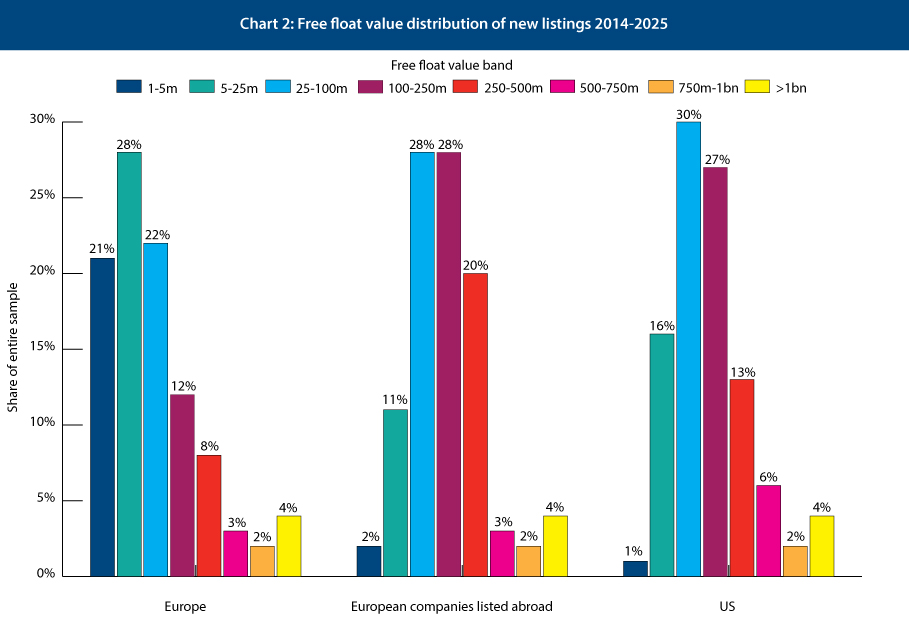
Take European companies listing in Europe since 2014. These companies have listed with a lower free float market value – the total value of shares available for public trading at IPO24 – than their US counterparts. A lower free float value can both reflect fewer shares being made available to the public and a lower value of these shares at IPO. While more than 72 per cent of European companies listed with a free float value below €100 million, the corresponding figure in the US was 49 per cent. Almost half of European companies list with free float values between €1–25 million, compared with less than 20 per cent of US firms (Chart 2). European companies listing abroad – usually in the US but also in Hong Kong and elsewhere – tended to do so with a higher free float value than their counterparts that remained in Europe.
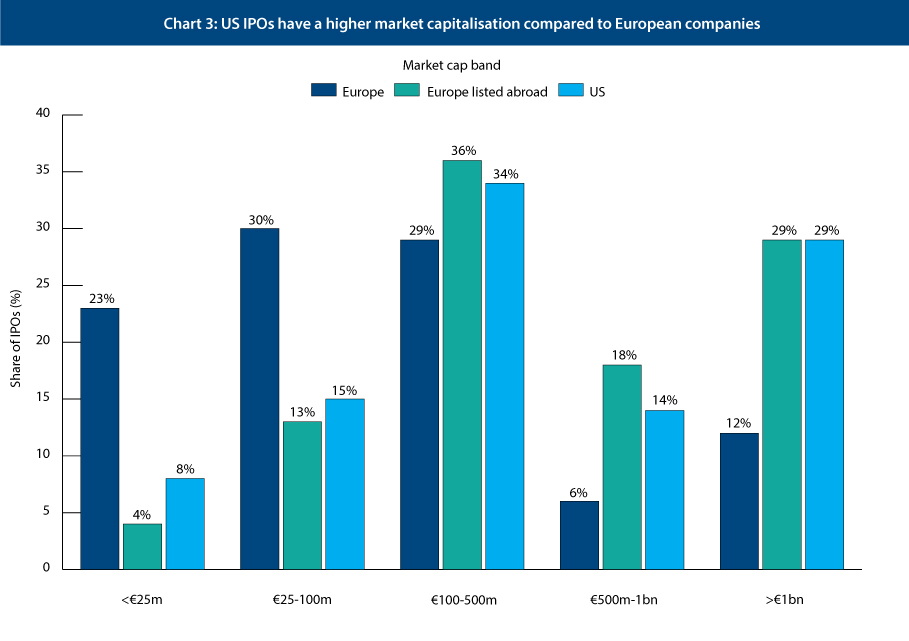
The difference is not limited to the size of the free float. European companies also tend to have lower total market capitalisations at the time of listing. Only 12 per cent of European companies listing between 2014-2025 reached a market capitalisation of €1 billion at the time of listing compared to over 29 per cent of US-based companies (Chart 3). Put simply, Europe not only produces smaller IPOs in terms of the value of shares made available to public investors; the companies going public in Europe also tend to be smaller overall.
The issue is thus not only that European stock markets provide too few opportunities for European firms to grow. Europe also produces fewer large, high-growth companies capable of attracting substantial investor interest and capital. For European markets, this is worrying for several reasons, starting with stock performance. The performance of small- and mid-cap companies in public equity markets has been underwhelming in recent years: over the last five years to July 2026, the S&P Europe SmallCap Index returned 1.27 per cent versus 7.55 per cent for the S&P Europe 350.25 Another manifestation of small IPOs in Europe is that over 55 per cent of firms in our sample list on a ‘growth market’ – a stock exchange segment open for smaller companies with lighter regulatory requirements. This matters, because existing growth markets have also been associated with relatively poorer performance and low liquidity. Historical European evidence suggests substantial long-term underperformance of growth market IPOs compared to main market IPOs.26
Second, smaller listings are typically less attractive to institutional investors. Institutional investors are important for public equity markets because their professional investment activity and scale can lead to more efficient price-setting and capital allocation, and contribute to depth and liquidity, therefore contributing to the attractiveness of the markets.27 Apart from long-term returns, institutional investors make investment decisions based on stock volatility – whether the company’s share price is exposed to rapid changes in the market – liquidity and analyst coverage of companies. With a lower free float, fewer shares are publicly available and traded, exposing the share price to significant swings from large transactions, making it more difficult to build and sell larger positions. Smaller companies are usually not as well covered by analysts, further complicating investment decisions.28
These dynamics of small listings are problematic because of their proportion within the wider market. Deep markets such as the US can more easily absorb a large number of smaller company IPOs relative to the market. In Europe, small IPOs account for a disproportionately large share of new listings, which reduces the market’s appeal to institutional investors. Together, these factors risk reinforcing the perception that European public equity markets are less liquid, less attractive to institutional capital and less capable of supporting large-scale listings.
How to strengthen European IPOs
European markets face serious challenges: fragmentation, perceptions of low liquidity, and firms listing too small. Tackling these issues requires a broad policy response rather than shortcuts such as one single stock exchange or lowering listing requirements. First, Europe should deepen capital markets through pension reform and incentivising greater retail investment. Second, the EU should encourage market-driven integration to improve liquidity and efficiency. Third, the EU should help companies scale to reach a larger size by the time they are initiating an IPO.
Unlocking European savings to boost European listings
Europe should put more of its citizens’ €10 trillion in savings – today held in safe but low-return bank deposits – to work in public equity markets, through pension funds and retail investment. Diversified equity investments tend to generate higher returns over time compared to, for example, government bonds. Investors also often exhibit ‘home bias’, whereby they direct a larger percentage of their investment portfolio to domestic or euro area markets than the size of that market would lead one to expect.29 Putting more household savings to work in capital markets would boost savers’ returns, increase funding for European firms and deepen the pool of capital supporting IPOs.
Drawing European savings to capital markets would make Europe a more attractive place for companies to go public. With greater investment, European markets would deepen – improving liquidity and valuations – thereby providing more funding for companies to scale. Institutional investors, such as pension, insurance and investment funds, are key to providing the demand that European equity markets need. Pension funds are especially valuable because of their size and long-term investment horizon, which enables greater risk-taking. Besides their equity investment, a portion of these funds’ investments goes toward private equity (PE) and VC funds that help build the pipeline of companies ready to undergo an IPO.
In this context, reforming pension systems and encouraging other institutional investment provide an opportunity for European governments. Most member-states’ pension systems are based on a ‘pay-as-you-go’ model, where taxes raised from existing workers are transferred to retirees. This model is under increasing strain as European populations age. If a larger share of savings were directed toward pension funds – and a portion of these funds were allocated to equities – it would strengthen stock market development and help relieve the burden of pension systems on public budgets.30 The potential gains are significant. The Economist estimates that $1.5 trillion could flow to European companies if EU pension assets reached 140 per cent of GDP (as in the US), if these were invested in equities to the same extent as in Nordic and Dutch pension schemes, and if just a fifth of that equity investment remained in Europe.31
Countries like Denmark and Sweden show that this is possible: they have both ensured high pension savings and directed large portions toward capital markets (Chart 4). They are also amongst the most innovative countries in Europe.32 A common feature of their pension systems is a shift, at least in part, from a defined benefit system (whereby individuals are guaranteed a certain amount for each year of their retirement but the amounts are typically raised from tax revenue) to defined contribution (where individuals and employers contribute a defined amount, pre-funding a retiree’s income). In defined contribution schemes, a pension manager or account holder invests these contributions, which are expected to grow over time, but without guarantees.
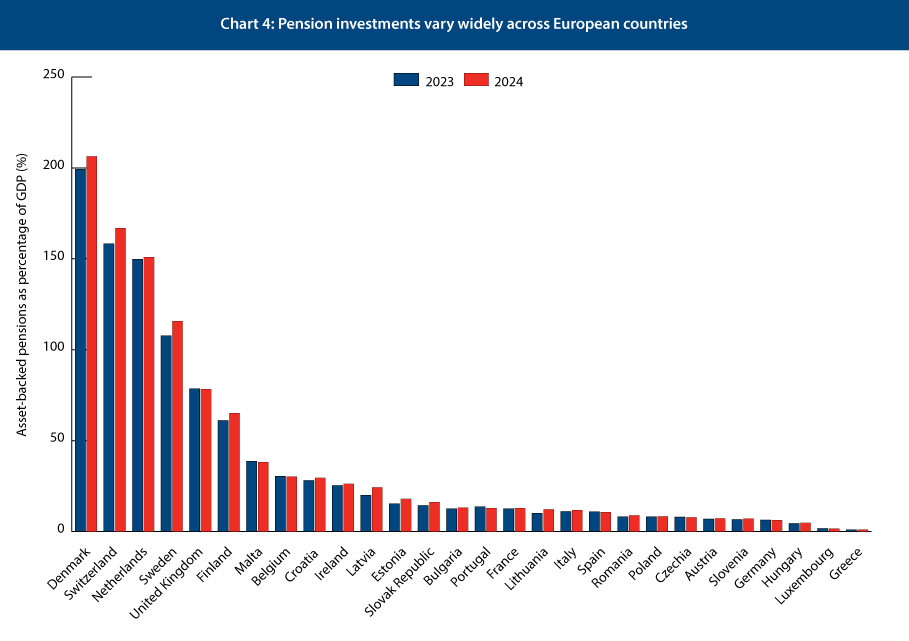
Sweden, in particular, has successfully enabled households and institutions to invest in its capital markets, helping it develop the strongest risk capital ecosystem in Europe.34 Stockholm has instituted mandatory and quasi-mandatory pension contributions, which are tied to capital markets in various ways. Sweden has also encouraged retail investment in equities through tax incentives, financial literacy and readily accessible investment platforms. Yet what sets Sweden apart is its investors’ high allocations to equities. With this strong equity demand comes home bias: domestic investors hold 45 per cent of Sweden’s total public equity capital – well above the EU average of 30 per cent. Factors like impressive market performance and strong stakeholder rights have contributed to this dynamic. But most importantly, Sweden has had numerous policies that require or encourage savings to be invested in capital markets, which together, over time, have created a strong risk-taking culture and investment expertise.35
In mandating that individuals contribute to their pension, national governments should empower fund managers to invest in equities and other high-growth assets. The best way to do this is for member-states to transition pension contributions from defined benefit to defined contribution systems, as Sweden and others have done, which will drive funds toward higher-return investments like equities. Member-states should also incentivise household equity investing through tax-preferred structures, such as Sweden’s Investment Savings Accounts. The EU has a more limited role to play, but it could incentivise reforms by showing greater leniency on fiscal targets to countries undergoing meaningful capital market and pensions reform.36
Directing more savings into capital markets will not fully solve Europe’s challenges, but it still matters. Not all additional capital will flow into equities and remain in Europe: ageing populations may reduce equity allocations, while savers will invest where they expect the highest returns. But even a modest European allocation from a much larger pool of assets could provide substantial funding for European companies, directly through equities and indirectly through VC and PE funds. Rather than mandating domestic investment, policy-makers should focus on increasing funded pension savings, giving fund managers greater investment freedom and making European businesses attractive investment opportunities.
Enhancing the functioning of European equity markets
Deepening national markets alone will not be sufficient to keep companies from listing abroad. To achieve the required scale and liquidity, the EU also should take steps to better integrate its equity markets.
German Chancellor Friedrich Merz and others have floated the idea of a single European stock exchange, often described as a ‘European Nasdaq’.37 However, forcibly creating such a structure would be putting the cart before the horse. The root of the problem is the fragmented regulatory environment and associated infrastructure barriers that make cross-border trading and operations costly: if these barriers persist and prevent exchanges from reaping economies of scale, cross-border mergers might not be economically viable. Hence, policy-makers should be cautious about attempting to engineer mergers directly. Furthermore, the need for consolidation has already been reduced through technological advances, which made it easier for investors to trade across exchanges.38
Policy-makers should focus on reducing legal fragmentation, and consolidation will follow. Key obstacles remain in securities law, taxation and the fragmented clearing and settlement landscape. The European Commission’s Market Integration and Supervision Package (MISP), which is currently being negotiated, will be a helpful step in this direction. Among other measures, it would give the European Securities and Markets Authority (ESMA) direct supervisory authority over the biggest stock exchanges, reducing the bureaucratic burdens associated with dealing with multiple national supervisors and diverging regulatory practices. This could shift the cost-benefit calculus of further consolidation. However, once incentives for cross-border business and mergers are in place, it is important that the EU’s competition law framework is well calibrated to ensure that exchanges can actually consolidate. The new Draft Merger Guidelines could be a step in the right direction. By giving greater weight to the potential competitive benefits of scale and introducing resilience as a parameter of competition, the Commission could create more room to consider the benefits of consolidation.
A more direct way to overcome market fragmentation, which is worthy of further analysis, would be to create a new pan-European growth market for promising young companies. This would differ from existing growth markets: first, by creating a pan-European market segment that concentrates more liquidity than national growth markets. And second, by being more restrictive on which companies are allowed in: existing growth markets have had mixed success. Many companies on these markets are very small and struggle to attract institutional investors. Their poor performance can undermine the attractiveness of the wider market segment. Therefore, a new growth market should target later-stage growth companies that have demonstrated their potential, for example, by attracting professional VC or PE backing, and meet a minimum market capitalisation requirement. Generally, the listing standards should be high enough to reassure investors about the quality of listed companies, but not so onerous that they deter promising firms.
The growth market could be created as a common listing segment in the form of a ‘28th regime’. Stock exchanges in all 27 member-states could offer an access point to a single, shared order book. A European growth market accompanied by a European growth-company index could create a recognisable pool of high-quality growth companies, increase their visibility and attract institutional and passive investment. Further research and market testing would be necessary to determine whether such a market would have sufficient liquidity and size to be worthwhile. Moreover, the European Commission should only proceed if there is a viable number of stock exchanges prepared to partner with it in launching the growth market.
Additionally, improving transparency between stock exchanges would lead to a more efficient flow of liquidity. The consolidated tape for equities39, expected to go live in September 2026, summarises data on completed trades and the paid prices (‘post-trade data’) across European venues, as well as the best available bid and offer in the market (‘pre-trade data’). Since shares of one company are often traded across multiple venues, compiling data in this way will improve transparency and market efficiency whilst increasing competition between European stock exchanges. It could also give investors a clearer picture of the liquidity of Europe’s stock exchanges. As part of the MISP, the European Commission has proposed expanding the information available via the tape by identifying the trading venue with the best price and listing the available volumes, and displaying prices offered by investment firms dealing outside a trading venue.40
Finally, Europe’s IPO woes have galvanized efforts to lower barriers to listings, but it is important to proceed with caution. While policy-makers should strive to remove unnecessary administrative requirements, as the EU’s recently enacted Listing Act does, they should avoid measures that would undermine market transparency and enable smaller companies to list. In fact, in 2021 the UK raised the minimum market capitalisation from £700,000 to £30 million to attract more high-growth businesses, based on the reasoning that this should reduce stock price volatility and improve investor confidence.41
Supplying the next generation of IPOs
More money chasing shares will achieve little if Europe does not also produce companies worth investing in. From incorporation onwards, European companies face incentives to look abroad: founders may incorporate in Delaware to access capital; growing firms may turn to foreign investors; and fragmented European markets can make the US a more attractive commercial and eventual listing destination. Europe therefore needs to improve the conditions for companies to establish, scale and ultimately go public at home. Two areas stand out.
First, Europe should support companies in growing across borders in Europe, which necessitates further single market integration. The size of European companies is strongly correlated with home-country GDP, whereas for US firms, home-state GDP seems unrelated to their size.42 This indicates that European companies are constrained by the size of their home markets, reflecting legal fragmentation – for example in company and tax law – and differences in product and service standards across member-states that hamper cross-border growth. A better-functioning single market would not only allow firms to grow in Europe, but also deepen their ties to the continent through a larger customer and investor base, making them more likely to ultimately list here.
The European Commission’s ‘EU Inc.’ proposal is a good first step to make it easier to found and scale businesses across Europe. However, it will probably not eliminate incentives to incorporate abroad or address the broader single market challenges.
To maximise the economic potential of EU Inc, the EU and its member-states should complement it with harmonised insolvency rules.43 This would provide investors with greater certainty about the treatment of their investments in the event of bankruptcy across Europe, enabling them to lower risk premiums and encourage cross-border investment.
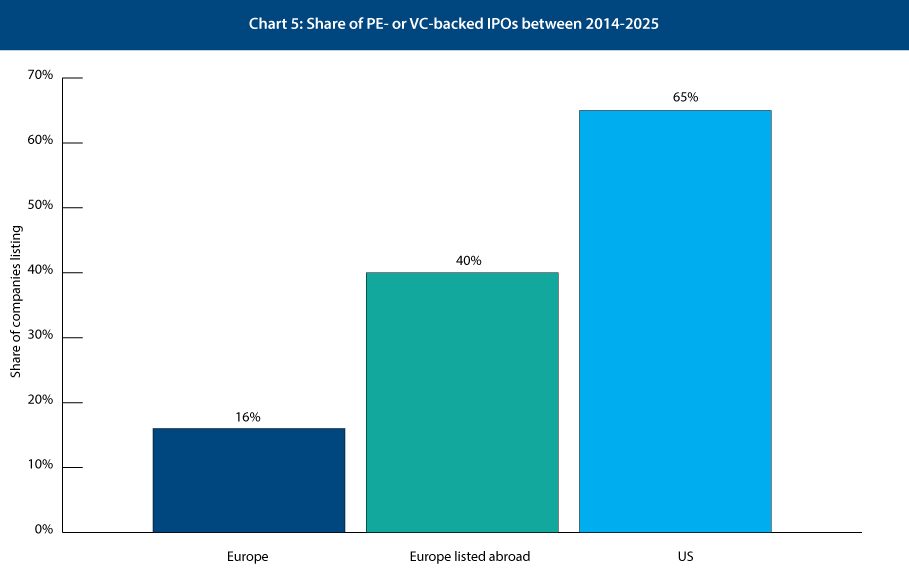
Second, Europe should promote the emergence of larger growth funds. To reach a sufficiently large scale before pursuing an IPO, companies need risk capital, which is still constrained in Europe – especially for late-stage financing. In our data, only 16 per cent of European companies listing in Europe had received PE or VC funding, whereas over 65 per cent of companies in the US were PE- or VC-backed (Chart 5).
Improving growth funding in Europe could take several avenues: using public capital to support growth-stage investment, incentivising institutional investment and reducing barriers to the growth of VC funds. First, the Commission recently launched the Scaleup Europe Fund with a public anchor commitment of €1 billion. The fund aims to reach a fund size of €5 billion, with investments of around €100 million. The privately managed fund pools public and private money and allows institutional investors to place significant investment sums thanks to its large size. However, a single fund of only €5 billion – which focuses only on late-stage funding rounds and a limited number of tech sectors – is far from sufficient to close the scale-up gap with the US. The EU should build on the Scaleup Europe Fund with more such initiatives to provide a meaningful boost to innovative companies in Europe.
A second path is to encourage institutional investment in VC. While EU rules generally allow pension funds to invest in risk capital under the ‘prudent person’ principle44, some member-states impose additional quantitative limits on how much pension funds can allocate to PE and VC. Relaxing overly restrictive limits could give pension managers greater scope to finance European growth companies. The Commission has already proposed changes to the Directive on Institutions for Occupational Retirement Provision and the Solvency II Directive for insurers, to allow more risk-tolerant investment.
These reforms alone may, however, not be sufficient. Large institutional investors may still find it inefficient to analyse a €100 million fund to acquire only a relatively small stake. A fund-of-funds – a fund pooling capital from investors to allocate to several underlying VC funds – would reduce risk and administrative costs and make VC investment more attractive to institutional investors.45 The EIB Group, in particular the European Investment Fund (EIF), should build on existing vehicles such as the European Tech Champions Initiative (ETCI). The ETCI 2.0 already aims to attract institutional investors together with public capital. The EIF should evaluate ETCI’s success in attracting pension funds and insurers and expand the model together with member-states to additional sectors and funding stages. Lastly, the planned review of the European Venture Capital Fund (EuVECA) Regulation should address regulatory barriers preventing growth funds from scaling and raising capital across borders.
Conclusion
Europe has made competitiveness a political priority, but closing the productivity gap with the US requires supporting innovative companies at every stage of their growth journey.
Reviving Europe’s IPO market is therefore part of a broader challenge. But fixing the weaknesses of European stock markets requires resisting some tempting shortcuts. While a single European stock exchange could help to concentrate liquidity, it would not by itself create the investor demand that companies need. Nor would simply lowering listing requirements produce larger IPOs. Europe instead needs more European savings invested in equities to deepen markets, more integrated equity markets to pool liquidity, and a single market that allows promising companies to grow to sufficient scale.
Europe has taken steps in each area, but greater ambition is needed. A healthier IPO market would do much more than generate economic gains: it would strengthen European sovereignty by enabling companies in strategic sectors to grow in Europe and avoid unwanted foreign acquisitions or listing abroad. Europe’s challenge is therefore to complete the circle – from founding, to scaling, to listing and back to funding the companies that come next.
Notes on methodology
The data for calculations were derived from the Deals Screener and the company level data of the London Stock Exchange Group.
Notes on our methodology:
- Countries covered: EU-27, the United Kingdom, Switzerland, Norway and the United States.
- What constitutes an IPO: companies going public on any exchange in Europe, the US, or elsewhere.
- Exclusions: trust funds, non-operative holdings, and shell companies (including Special Purpose Acquisition Companies – SPACs); listings with a free float value below €1 million, which typically represent technical admissions rather than genuine capital-raising events.
Building our sample: We used the LSEG Deal Screener dataset to identify IPOs between January 2014 and December 2025 in the above countries, complemented with company-level data on market capitalisation and post-IPO performance (measured from the first trading day using adjusted closing prices).
We excluded non-operative companies, such as holdings, trust funds and shells. This included SPACs, which comprised 40 per cent of the initial US sample. We further excluded listings with a free float value below €1 million, which typically represent technical admissions rather than genuine capital-raising events.
Our final sample came to 1933 IPOs for the European sample and 144 European-headquartered companies that listed on a non-European exchange (primarily in the United States). For the United States we reached a sample of 1519 IPOs.
2 Benjamin Böninghausen, Johanne Evrard, Zakaria Gati, Sofia Gori, Claudia Lambert, Daniel Legran, Wagner Eduardo Schuster & Fons van Overbeek, ‘Should we mind the gap? An assessment of the benefits of equity markets and policy implications for Europe’s capital markets union’, ECB Occasional Paper Series No. 373, European Central Bank, August 6th 2025.
3 Leslie A. Jeng & Philippe C. Wells, ‘The determinants of venture capital funding: evidence across countries’, Journal of Corporate Finance, Vol. 6, No. 3, September 2000, pp. 241–289.
4 Bernardo Bortolotti, Frank de Jong, Giovanna Nicodano and Ibolya Schindele. ‘Privatization and stock market liquidity’, Journal of Banking & Finance, 2007; William Wright, James Thornhill, Christopher Breen & Matilda Hames, ‘A reality check on international listings’ New Financial, April 2025.
5 Yakov Amihud & Haim Mendelson, ‘The Liquidity Route to a Lower Cost of Capital’, Journal of Applied Corporate Finance, Vol. 12, No. 4, 2000, pp. 8–25.
6 Willem Van Zandweghe, ‘Do Changes in the Stock Market Affect Consumer and Business Confidence?’, Economic Bulletin, Federal Reserve Bank of Kansas City, January 9, 2019; W. Jos Jansen & Niek J. Nahuis, ‘The stock market and consumer confidence: European evidence’, Economics Letters, Vol. 79, No. 1, April 2003, pp. 89–98.
7 & 8 European Investment Bank, ‘Drivers of relocation by innovative EU startups and scaleups’, January 12th 2026.
9 Jörg Kukies & Christian Noyer, ‘Final Report of the FIVE Task Force: Financing Innovative Ventures in Europe’, FIVE Task Force, January 19th 2026.
10 The growth of private equity also plays a role in explaining the current dearth of European IPOs because it gives companies access to substantial financing with lower reporting and governance burdens compared to going public.
11 William Wright, James Thornhill, Christopher Breen & Matilda Hames, ‘A reality check on international listings’, New Financial, April 2025.
12 Chiara Fratto, Matteo Gatti, Anastasia Kivernyk, Emily Sinnott & Wouter van der Wielen, ‘The scale-up gap: Financial market constraints holding back innovative firms in the European Union’, European Investment Bank, June 2024.
13 European Commission, ‘The EU Startup and Scaleup Strategy’, COM(2025) 270 final, May 28th 2025.
14 Euronext, ‘Demystifying the liquidity gap between European and US equities’, April 18th 2024.
15 William Wright, James Thornhill, Christopher Breen & Matilda Hames, ‘A reality check on international listings’, New Financial, April 2025.
16 CCPs and CSDs facilitate the exchange between buyers and sellers in capital markets, with CCPs contracting with the buyer and seller of a trade and CSDs handling the final handover of the security and the payment.
17 & 18 Jörg Kukies & Christian Noyer, ‘Final Report of the FIVE Task Force: Financing Innovative Ventures in Europe’, FIVE Task Force, January 19th 2026.
19 Benjamin Böninghausen, Johanne Evrard, Zakaria Gati, Sofia Gori, Claudia Lambert, Daniel Legran, Wagner Eduardo Schuster & Fons van Overbeek, ‘Should we mind the gap? An assessment of the benefits of equity markets and policy implications for Europe’s capital markets union’, ECB Occasional Paper Series No. 373, European Central Bank, August 6th 2025.
20 PitchBook, ‘Why a US listing might not always be the best path for Europe’s startups’, March 26th 2025.
21 William Wright, James Thornhill, Christopher Breen & Matilda Hames, ‘A reality check on international listings’, New Financial, April 2025.
22 Stefan Weik, Ann-Kristin Achleitner & Reiner Braun, ‘Venture capital and the international relocation of startups’, Research Policy, Vol. 53, No. 7, September 2024, Article 105031.
23 William Wright, James Thornhill, Christopher Breen & Matilda Hames, ‘A reality check on international listings’, New Financial, April 2025.
24 Calculated as shares offered to the public multiplied by the offer price at IPO.
25 S&P Dow Jones Indices, ‘S&P Europe SmallCap’; S&P Dow Jones Indices, ‘S&P Europe 350’, performance data as of July 31st 2026.
26 Silvio Vismara, Stefano Paleari & Jay R. Ritter, ‘Europe’s Second Markets for Small Companies’, European Financial Management, Vol. 18, No. 3, June 2012, pp. 352–388.
27 OECD, ‘Institutional Investor Engagement and Stewardship’, OECD Publishing, Paris, December 2nd 2025; European Central Bank, ‘Statement by the ECB Governing Council on advancing the Capital Markets Union’, March 7th 2024.
28 William Wright, James Thornhill, Christopher Breen & Matilda Hames, ‘A reality check on international listings’, New Financial, April 2025.
29 Zsolt Darvas & Dirk Schoenmaker, ‘Institutional investors and home bias in Europe’s Capital Markets Union’, Bruegel, March 6th 2017; Nicolas Coeurdacier & Hélène Rey, ‘Home Bias in Open Economy Financial Macroeconomics’, NBER, July 2013; Luis Molestina Vivar, Claudia Lambert, Michael Wedow and Margherita Giuzio, ‘Is the home bias biased? New evidence from the investment fund sector’, ECB, 2020.
30 Shujaat Khan, Bo Li and Yunhui Zhao, ‘Pension Reform and Stock Market Development’, International Monetary Fund, February 28th 2025; Marie-Sophie Lappe & David Pinkus, ‘Size versus allocation in capital market development: Evidence from pension funds and insurance companies’, Bruegel, June 2nd 2026.
31 The Economist, ‘European pensions are a $30trn missed opportunity’, March 4th 2026.
32 European Commission, ‘European Innovation Scoreboard 2026’, 2026.
33 OECD, ‘Asset-backed pensions - main database’.
34 Nikou Asgari, ‘How Sweden’s stock market became the envy of Europe’, Financial Times, April 18th 2024.
35 OECD, ‘The Swedish Equity Market’, April 29th 2025; OECD, ‘The Swedish Equity Market, Assessment and Policy Recommendations 2026’, April 28th 2026.
36 Aslak Berg, Elisabetta Cornago, Zach Meyers and Sander Tordoir, ‘A reform agenda for the single market’, Centre for European Reform, October 16th 2025.
37 Financial Times, ‘German Chancellor Friedrich Merz calls for single European stock exchange’, October 16th 2025.
38 William Wright & Sean Tuffy, ‘The future of European equity market structure’, New Financial, October 2025.
39 A consolidated tape collects and reports real-time data of stocks that are traded on an exchange, including prices and trading volume. The information can be used to make better buy-and-sell decisions.
40 European Commission, ‘Questions and answers on the market integration package’, December 4th 2025.
41 Travers Smith, ‘Listing Regime Rule Changes: The first step is always the hardest’, December 3rd 2021.
42 Bo Becker, Efraim Benmelech & Joao Monteiro, ‘The Value Gap: Europe Cannot Scale’, NBER Working Paper No. 35577, National Bureau of Economic Research, August 2026.
43 Allan Dizioli, Alexandra Fotiou & José M. Garrido, ‘Toward a 28th European Enterprise Regime: A Single Rulebook to Enable Cross-Border Scale-Up in Europe’, IMF Departmental Paper No. 2026/014, July 23rd 2026.
44 The principle foresees fund managers to act in the long-term interests of beneficiaries and ensure that portfolios are appropriately diversified, secure and liquid.
45 European Commission, Directorate-General for Financial Stability, Financial Services and Capital Markets Union, CIVITTA, EBAN & Bourse Consult, ‘Study of barriers to, and drivers of, the scaling-up of funds investing in innovative and growth companies’, 2025.
By Claudia-Dominique Geiser, Senior Expert, EU Economic Policy, Bertelsmann Stiftung, James Green, Research Fellow, Centre for European Reform and Marlene Schörner, Policy Fellow, EU Financial Markets, Jacques Delors Centre
September 2026
Download full publication
View press release
Related content