
How Europe can strengthen transatlantic relations through Congress and the US states
Europeans cannot change Donald Trump’s foreign policy, but the period after the midterm elections offers an opportunity for the EU and member-states to strengthen relationships with Congress, US states and the next generation of American leaders. Investing in these networks now is essential to securing the future of the transatlantic alliance.
Europe has had a rocky ride with the second Trump administration. While a future US administration might be less hostile to Europe, a return to the previous status quo is unlikely. America has changed, and so has Europe. Even so, US foreign policy remains important to European interests and the EU needs to rethink how it tries to shape it. The pillars of transatlantic relations persist: the American public continues to support US membership of NATO and have favourable views of Europe, and many in Washington, DC understand the necessity of strong transatlantic bonds.
With deeper and broader engagement, the EU can soften the blows of harmful US policies and build on existing pillars to strengthen long-term relations. This paper outlines how to build stronger networks at the sub-national level and with the US Congress to improve the EU’s influence in the US. While such influence is unlikely to yield results for the remaining two years of this administration, it is the right time to start laying the groundwork for stronger transatlantic relations with future administrations.
With deeper and broader engagement, the EU can soften the blows of harmful US policies and build on existing pillars to strengthen long-term relations.
Playing the long game through Congress
The US Congress remains a key vehicle through which the EU can influence US foreign policy in mutually beneficial ways. Across administrations, Congress’ role in foreign policy has declined as it has delegated authority and deferred to the President on war, tariffs and more – while this President has also actively sought to expand presidential powers.
Nonetheless, the legislative branch still plays a valuable role in policy decisions affecting the EU. Perhaps most importantly, Congress still retains authority over US federal spending, including financial support for Ukraine, and can legislate on taxes and trade, although it has ceded considerable authority to the President in the latter. It also steers Pentagon policy through the annual National Defence Authorization Act (NDAA), which authorises spending levels and establishes policy for the Department of Defense and other security agencies. EU countries’ relationship with Congressmen and women therefore matters and is worth shaping.
The November midterms create a particular opportunity for European capitals, the EEAS and the European Commission to shape the new cohort’s views on Europe, transatlantic relations and NATO. The elections will inject a host of new faces into both the House and Senate (Chart 1). There is already very high turnover due to retirements and incumbents losing primaries or pursuing another office: nearly one fifth of the House will be newly elected, if not more, assuming some incumbents lose on election day, as seems likely. The elections will also likely change the leadership of Congress and its committees, roles which yield significant influence over their respective party’s legislative positions and which legislation is voted on. Members of Congress have also proved influential in lobbying the President, including after their time in the legislature ends. It is common for federal lawmakers to make the jump to the executive branch or become state governors.
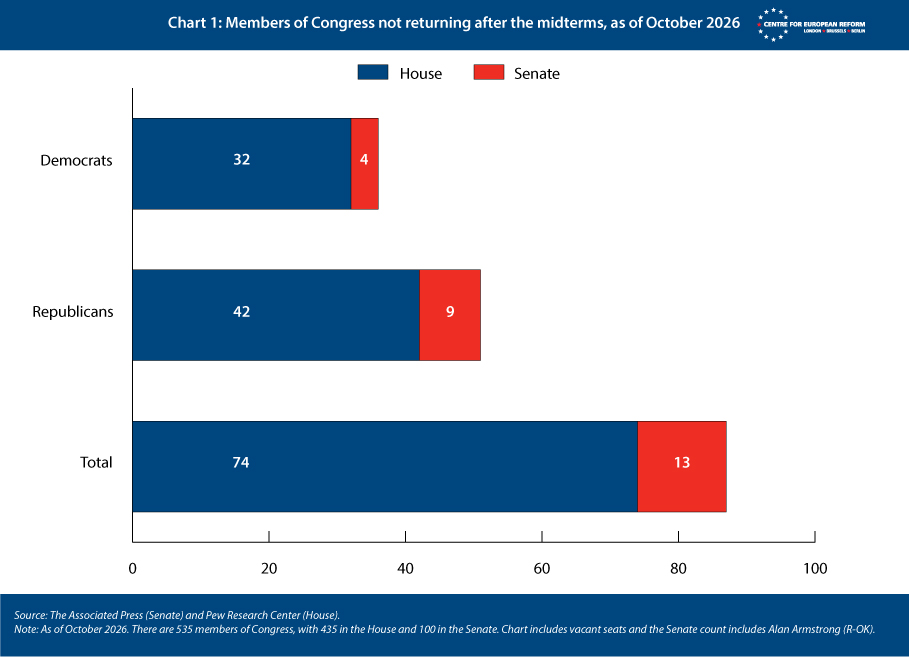
Yet, with this turnover, there is also risk. European governments cannot assume that the next generation of US political leaders will regard Europe as a priority. Some departing members, like US Senators Jeanne Shaheen, the current top Democrat on the Foreign Relations Committee and the late Republican Lindsey Graham, have been amongst Washington, DC’s staunchest transatlanticists and supporters of Ukraine. A generational shift is also likely to occur, with younger members assuming office or leadership positions as older members retire or are pushed out. While many older members came of political age at a time of heightened transatlantic unity during the Cold War and its immediate aftermath, younger members may not have that same attachment to the ‘old continent’ or the transatlantic alliance. This provides an opportunity for EU institutions and European capitals to be more proactive in shaping lawmakers’ positions toward Europe.
The EU Delegation to the US and member-states’ embassies should plan and execute an early engagement strategy with every new member of Congress. The precise strategy should be adapted to the member and their state or district, but the main message should showcase how EU countries create and support jobs in America and make Americans’ lives safer and more affordable. Many members of Congress do not have the interest, time or political incentive to engage in foreign policy, including in relation to Europe. Driving home how the EU affects their constituents – from Nebraska to North Carolina – can help bridge that gap. Citing figures like ‘the 300,000 jobs in Texas supported by trade with the EU’ help, but even more potent are individual stories in the communities of specific members of Congress that bring to life how trade, investment and defence translate into benefits that Americans can understand. The EU and its member-states should also partner with think-tanks in Washington, DC from across the political spectrum to leverage their convening power to engage lawmakers, and encourage lawmakers to travel to Europe through congressional delegations (CODELs), and participation in the NATO Parliamentary Assembly.
The EU Delegation to the US and member-states’ embassies should plan and execute an early engagement strategy with every new member of Congress.
In addition to ‘rank and file’ members of Congress, the EU must engage with Congressional leadership – namely the majority and minority leader in each chamber, their deputies and the relevant committee chair and ranking member – to make its voice heard, especially in the House. This group of legislators is particularly important in negotiating large, must-pass legislation like annual funding bills and the NDAA. In the latter, Congress has previously included provisions that constrain US troop withdrawals from Europe and prohibit the President from withdrawing from NATO without Congressional approval. Congressional leaders are bombarded by requests from their constituents, other elected officials and external stakeholders, so these leaders need to have absolute clarity on where the EU stands and what it wants when they are in time-sensitive negotiations.
To the extent possible, the EU should therefore focus on just one or two priority ‘asks’ to leadership, and also tailor these to each party. More specifically, Europeans should push Democrats to advocate for NATO membership for Ukraine, and they should push Republicans to tighten sanctions on Russia. Second, Europeans should ask members of both parties to advance EU-US alignment and coordination on China, especially on economic issues. China is one of the few areas of true bipartisanship left in Washington, DC, and the EU has been converging with China hawks’ positions regarding Chinese trade and economic security. Europeans should therefore emphasise these areas of convergence without suggesting that their interests are identical to those of Washington, DC. The challenge will lie in EU countries’ ability to coalesce around these specific asks, but doing so will heighten its effectiveness on the Hill.
To be clear, Congress’ ability to halt Trump’s most egregious actions is limited – even in a future where Democrats win one or both chambers. This is even truer during Trump’s second term where administration officials may ignore Congressional subpoenas and try to steamroll Congress. However, Congress still has valuable chips to play for Europe. Engaging with Congress can produce more concrete, lasting US policy than any President can provide. It is also the foundation for building relationships with future state and executive branch leaders. With Congress, the EU is playing the long game, but it is a game worth playing.
Creating a collaborative network through the US states
Congress is not Europe’s only lever for more influence in the US. European countries can also exert greater sway over US policy by working better through US states. Currently, EU member-states with representations in regional US hubs (Chart 2) treat their operations through a purely national lens. EU countries’ consulates have different mandates: some focus on bilateral trade promotion, others on advancing cultural ties, and others on region-to-region engagement. Some countries only allow their embassies in Washington, DC to engage at the political level, and restrict their consulates from engaging on political issues. The EU has limited presence with its delegation in Washington, DC and a small satellite office in San Francisco. The result is a wildly fragmented landscape of European representation outside of Washington, DC, in which national interests prevail rather than the European collective interest.
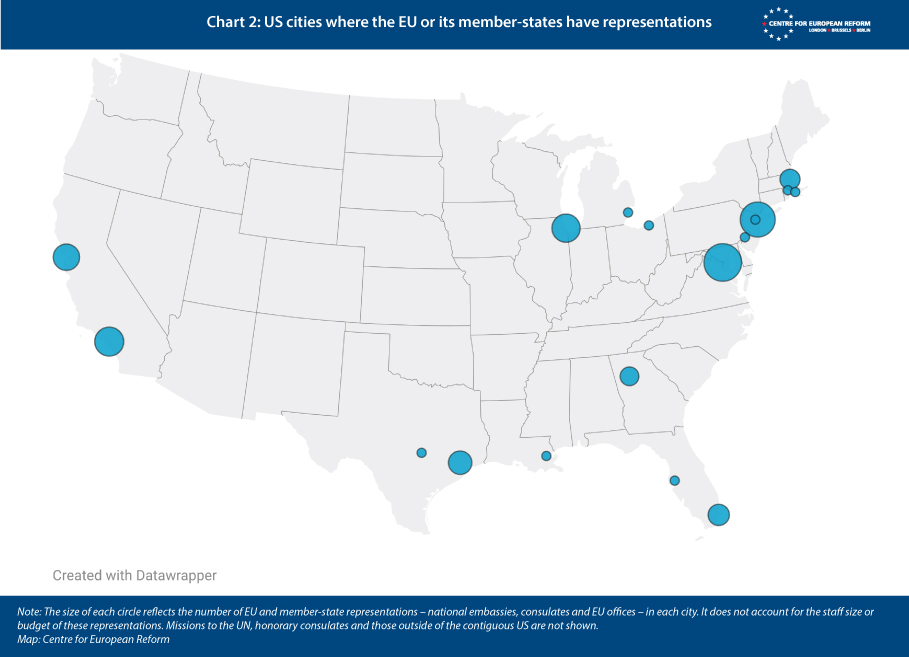
European countries should improve their co-ordination not only between European embassies in Washington, DC, but also use their consular network across the country more effectively. National governments should give consuls-generals and their teams greater flexibility to engage in political discussions just as much as embassies in Washington, DC. Doing so effectively requires more adequate staffing. Currently, staff levels in European consulates are not proportional to the respective size and importance of some US states, especially when considering the trade volumes. As an example, California’s services exports to the EU amounted to $46.1 billion (approx. €40.8 billion), more than the €37.9 billion in services imports from India in 2025. European countries and the EEAS should staff their US regional representations as they would countries of that size and importance in terms of trade, rather than, in the case of the EU, cull EEAS delegation staff due to budget cuts.
The EU institutions themselves are hamstrung by only having a delegation in Washington, DC and a presence in San Francisco, making it more difficult to co-ordinate EU-wide positions in the states. The EU should develop a mechanism for co-ordinating EU positions not just in Washington, DC, but also through member-states’ consular offices throughout the country. This could be done by placing liaison officers in US states for which the trade volume is notably high, like Texas, California or New York. Their role would explicitly be to co-ordinate EU positions within the states and support sustained EU presence in the state. This would help overcome some member-states’ challenges with accessing key political figures, as not all member-states have equal access to state governors.
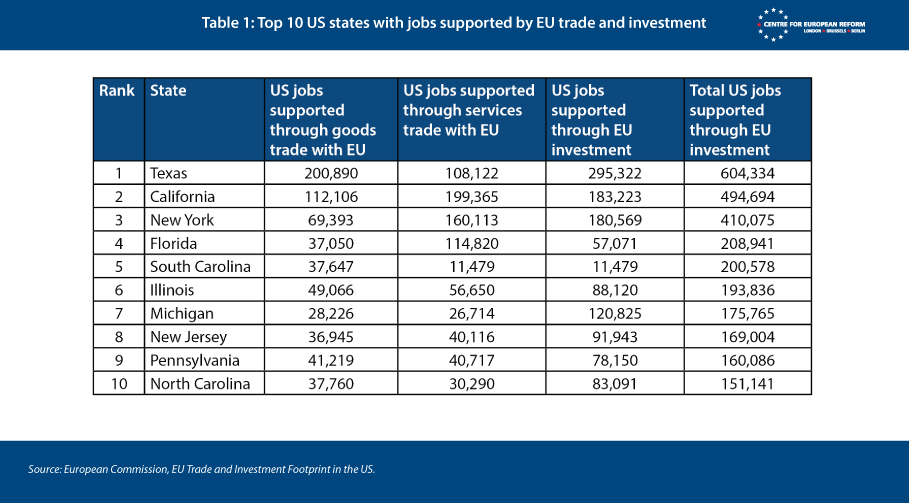
In addition to improving co-ordination in the US states, European countries should increase Europe’s visibility across the US, not just in Washington, DC. Part of the narrative around this should be about job creation and how EU countries and EU companies support the local economy. EU investment supports significant numbers of jobs in all US states (Table 1), yet this is not communicated sufficiently and hammered home to US lawmakers. As an example of good practice elsewhere, Canada has a database with granular data on the number of jobs that Canadian investment supports at the local level, allowing Canada to lobby Congress more effectively. Staff operating at the state level can also forge relationships with local officials and gather local stories about the impact EU-US trade has on families and communities, in turn allowing them to more effectively make their case in Washington, DC.
To improve co-ordination in the US states, European countries should increase Europe’s visibility across the US, not just in Washington, DC.
The EU and its member-states should also combine their efforts at the federal and sub-national level by holding an annual forum, or multiple fora, outside of Washington, DC that brings together business leaders, civil society and politicians from US states with their European counterparts. There are already political fora for policy-makers from across the Atlantic to come together. What is missing is an annual forum outside of the US capital that showcases Europe to ordinary Americans and their civil society leadership, whether those are churches, community groups, colleges or local businesses. One suggestion might be to host fora specifically focussed on transatlantic relations between that particular state or US region and Europe, for example, showcasing the ties between the Midwest and Europe.
To engage young people and the next generation, the EU could increase the number of accredited Jean Monnet Centres – EU-funded research centres embedded in US universities – in traditionally red states. Currently, there are such centres at universities like NYU, University of Florida, and North Carolina at Chapel Hill. Increasing their funding for public diplomacy activities under Erasmus+ would help students engage with Europe early on in their careers, and improve the visibility of the EU among the next generation. Erasmus+ should also fund a highly selective study programme for students who demonstrate leadership potential, involving a trip to Europe to visit and meet policy-makers, institutions and civil society in key European capitals.
Making Europe a more valuable partner for the US
Even if the Democrats win control of both chambers of Congress in the mid-term elections, Europeans will still have to deal with an administration that is economically, strategically and politically at odds with the EU and with most European governments. For his remaining years in office, Donald Trump is likely to continue to be more helpful to Europe’s adversaries than to America’s NATO allies.
However challenging the administration in Washington, DC, European governments should not give up on their relationship with the US entirely. The two continue to share interests and values, and Europe has other options to work with US decision-makers, whether in Congress or in the states. Congressional and sub-national engagement can help blunt the impact of harmful policies in the near-term and plant the seeds for more constructive relations in the future. While it will take time for the investment in these networks to yield results, there are steps the EU and European governments can undertake during the final years of the current administration to set themselves up for more positive relations with the US going forward. Diffusing influence much more broadly in the US, rather than focussing solely on Washington, DC is the cornerstone of a strategy to build broader political engagement.
However challenging the administration in Washington, DC, European governments should not give up on their relationship with the US entirely.
The elephant in the room, however, is whether US policy-makers are interested in engaging with Europeans. The demand from US policy-makers is often lacking, partially because Europe is not seen as the most pressing demand on policy-makers time, whether on Capitol Hill or in state Governors’ offices. Members of Congress and state governments are more likely to engage when Europeans can demonstrate the benefits of transatlantic ties for their constituents. European diplomacy needs to become more systematic, more locally focused and better co-ordinated across EU institutions and member-states.
Ultimately, however, Europe’s influence in the US will depend on more than diplomatic outreach. The EU will best improve its standing in Washington, DC, state capitals, cities and elsewhere by strengthening its own capacities. The stronger Europe’s economy, the greater its contribution to its own defence and the more indispensable its role in key global supply chains, the more valuable a partner it will be to Washington, DC. In doing so, the EU should look to change how American political leaders and voters understand Europe’s importance – moving away from Europe being seen as a collection of friendly but militarily weak states of decreasing international relevance, to a powerful geopolitical actor and an ally with common strategic interests that it wants on its team. This should coincide with discussions on a new vision for transatlantic relations that results in a more independent and assertive Europe. All easier said than done, but the period after the midterms offers an opportunity to begin.
Armida van Rij is a senior research fellow and James Green is a research fellow at the Centre for European Reform.
Add new comment