

Add new comment
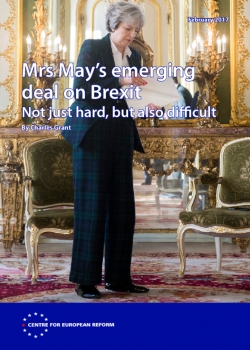
Mrs May's emerging deal on Brexit: Not just hard, but also difficult
- Theresa May has set out her plan for Brexit: the UK will leave the single market and the customs union, and seek a free trade agreement (FTA) with the EU. But in Brussels key policy-makers worry that she may not succeed – either because the ‘Article 50’ divorce talks collapse in a row over money, or because the two sides cannot agree on the transitional arrangements that would lead to the FTA.
- EU officials are pessimistic because they observe the pressure May is under from hard-liners to take a very tough approach to the negotiations. They see limited pressure on her for a softer Brexit. But several factors could favour a less-than-very-hard Brexit: a majority of MPs wants to retain close ties with the EU, as do business lobbies; and an economic downturn (if it happens) could steer public opinion away from supporting a clean break.
- In May’s government, 10 Downing Street takes all the key decisions. The downside of this centralisation is that decision-taking may be delayed, and particular proposals may be tested on too narrow a circle of experts.
- The outcome of the Brexit talks will be shaped to a large degree by the EU governments. They are mostly united in taking a hard line. Worried about the cohesion and unity of the EU, they do not want populist leaders to be able to point to the British and say, "They are doing fine outside the EU, let us go and join them." Exiting must be seen to carry a price.
- The British government has yet to decide what it wants on some key issues, such as: what sort of immigration controls should it impose? What kind of special deal, if any, should it seek for the City of London? What customs arrangements will it ask for? What sort of court or arbitration mechanism would it tolerate? And what transitional arrangements does it want?
The arrival of #Trump has boosted the self-confidence of those who want to cut ties with the EU.
- Britain’s strongest card is its contribution to European security. The arrival of Donald Trump could help the UK, by giving continentals an extra reason to keep the UK engaged; but if the British become too chummy with Trump, they will lose the goodwill of EU governments. Britain’s other cards are weaker. It regards the City of London as a European asset that should be cherished by all – but that is not how most of the 27 see it. Nor should the UK try to claim that since the 27 have a trade surplus with it, they need a good trade deal more than it does; the reality is that Britain depends more on EU markets than vice versa. Finally, May’s threat to respond to a bad deal by transforming Britain into a low-tax, ultra-liberal economy lacks credibility.
- There are only three possible outcomes of the Brexit talks: a separation agreement plus an accord on future relations including an FTA; a separation agreement but no deal on future relations, so that Britain has to rely on WTO rules; and neither a separation agreement nor a deal on future relations, so that Britain faces legal chaos and has to rely on WTO rules.
- Once Britain triggers Article 50, it is in a weak position: it must leave in two years, and if it has not signed a separation agreement before doing so, it risks economic chaos. So if Britain wants a half-decent deal, it needs the goodwill of its partners. That means ministers should be polite, sober and courteous. Grandstanding and smugness will erode goodwill towards the UK. As for the substance of the negotiations, the more that Britain seeks to retain economic and other ties, the more likely are the 27 to offer a favourable deal.
If MPs vote down the deal, the government may be obliged to ask the 27 for a softer #Brexit.
Whatever happens in the negotiations, Brexit will be hard. That is because both the UK and the 27 are placing politics and principles ahead of economically optimal outcomes. In the very long run, once both the UK and its partners have understood that a hard separation is not in anyone’s interests, serious politicians will start thinking about how to engineer closer relations.
Copyright is held by the Centre for European Reform. You may not copy, reproduce, republish or circulate in any way the content from this publication except for your own personal and non-commercial use. Any other use requires the prior written permission of the Centre for European Reform.