
What Orbán’s departure means for Hungary and for Europe
Hungary’s voters have ended Viktor Orbán’s 16-year rule. Tisza’s win is a unique chance to restore democracy – and a time-limited opportunity for the EU to emerge stronger.
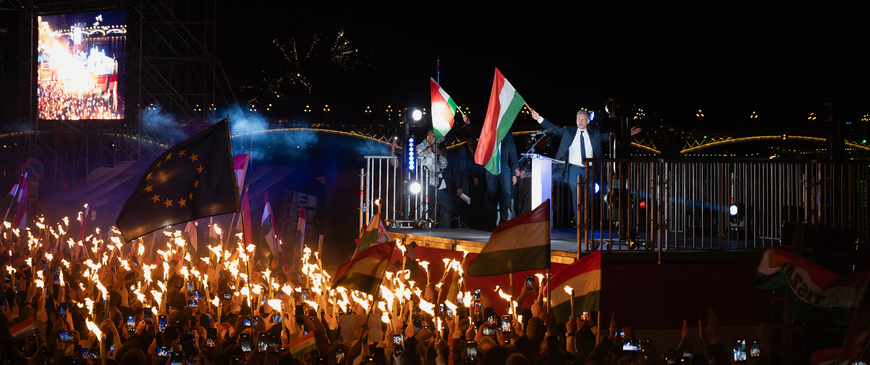
In a previously inconceivable turnaround, Hungary’s opposition have unseated Viktor Orbán after 16 years in power. Orbán completely reshaped Hungary’s constitution and institutional structure, transforming the country’s fragile democracy into a hybrid regime, where elections were “free but unfair”. Despite the obstacles the opposition faced – including an electoral system tilted in favour of the governing Fidesz and the abuse of state resources to help the incumbent – political upstart Péter Magyar and his centre-right Tisza party have delivered a decisive blow to Orbán’s system, securing a supermajority with the largest vote share since 1990.
According to the preliminary results, Tisza won 53 per cent of the votes, Orbán’s Fidesz received 38 per cent and the extreme-right party Mi Hazánk (Our Homeland) cleared the electoral threshold with 6 percent. This means that Hungary, on paper, will have its most right-wing parliament since its transition to democracy in 1990 – Tisza will have 138 seats out of 199, Fidesz 55, and Mi Hazánk 6. In practice, however, the new government will need to represent left-wing ideas as well, given that more than half of those who voted for Tisza identify as liberal or left-leaning/socialist.
Having secured a two-thirds supermajority in parliament, Tisza has a mandate to deliver far-reaching changes. But it cannot undo the damage that Fidesz’s rule did in 16 years overnight. Nor do the results mean that EU decision-making will now be plain sailing, with Orbán out of the way and a new Hungarian government on board. The EU will have to contend with a Hungary that promises to be a constructive but critical partner. Orbán’s disappearance might also expose previously hidden cracks among the other 26 member-states. On some issues, some member-states have been able to avoid open opposition, certain that Hungary would use its veto. With Orbán gone, these states might now have to show their colours.
Having secured a two-thirds supermajority in parliament, Tisza has a mandate to deliver far-reaching changes.
What does the outcome mean for Hungary domestically?
Tisza’s supermajority is a clear opportunity for Hungary to restore the rule of law, clean out corruption and clientelism and re-emerge as a European democracy.
To rebuild democracy, Tisza will need at a minimum to restore the independence of institutions – whether through dismissing people in charge or getting them to co-operate – and revoke laws that violate rights and freedoms. Magyar earlier claimed that Tisza does not want to be “Fidesz lite”, and promised to respect checks and balances, including by refraining from taking steps that violate the rule of law to restore the rule of law.
Among state institutions, the president, the prosecutor general, the head of the Central Bank, the State Audit Office, the Media Authority, the Curia (Hungary’s highest court), as well as the full bench of the Constitutional Court are stacked with former Fidesz politicians or loyal allies of the outgoing party. They could all present varying levels of opposition to Tisza's efforts to reverse Fidesz’s damage.
In his election night speech, Magyar called on the president, Tamás Sulyok, an Orbán ally, to hand in his resignation. While Hungary’s president does not have far-reaching powers, he could still slow down law-making by sending laws for a constitutional check. Should Sulyok decide to obstruct the new government, Tisza can remove him from office but only after getting the consent of the currently Fidesz-friendly Constitutional Court or after changing the constitution. Magyar’s broader approach to Fidesz’s appointees is that they should leave or, if they prove their democratic bona fides, fulfil their responsibilities independently and co-operate with the new government. Magyar named Central Bank chief Mihály Varga as someone who could potentially stay.
Among Magyar’s first promises are limiting the prime minister to two terms, a new constitution drawn up after a consultative process, and a referendum on that constitution. He also promised changes to the electoral framework. He wants Hungary to join the European Public Prosecutors Office (EPPO); to create a new institution to recover stolen assets; and to take the public broadcaster off the air temporarily – as happened in Poland in 2023 after the new government came to power – and draft a new media law.
Additionally, Magyar will need to address laws that European courts have ruled or are likely to rule violate rights and freedoms. These include the anti-LGBT+ law, which bans discussion and portrayal of LGBT+ people in schools and the media, and laws violating academic freedom and the rights of asylum seekers.
On the economy, Tisza's central pitch was unlocking approximately €17 billion in EU recovery funds as well as cohesion funds frozen under the rule of law conditionality mechanism. Releasing these funds would provide immediate fiscal relief to a struggling economy and improve market confidence. Hungary’s fiscal deficit has ballooned due to pre-election spending – by the end of March, the budget deficit reached 80 per cent of the annual target. Interest payments on debt remain high and, at the same time, public services are reeling from years of underinvestment. The country spends a bit over half of what its European peers spend on healthcare, while educationhas been similarly underfinanced. Tisza has pledged to rein in spending but also promised to cut taxes while boosting revenue – and for that, it is necessary to have access to the suspended funds.
What does the outcome mean for Hungary’s foreign and security policy?
On foreign policy, Tisza is both openly pro-European and pro-NATO. There was a clear turn in the last days of the election campaign and the vote increasingly appeared to be a referendum on Hungary’s EU membership. In line with that, Magyar pledged a ‘return’ to Europe and a restoration of Hungary’s position as a dependable ally, both in the EU and in NATO. Additionally, Tisza emphasises the importance of a “strong Central Europe within a strong Europe”, aiming to restore the relationship with the Visegrad countries, chief among them Poland. Tisza’s manifesto also placed significant prominence on protecting the rights of Hungarians living beyond Hungary’s borders.
Magyar pledged a ‘return’ to Europe and a restoration of Hungary’s position as a dependable ally, both in the EU and in NATO.
The relationship with Kyiv will likewise be among the priority issues for the new government, and Magyar said it is of primary interest to resolve current disputes. The first test of that relationship is what happens with the EU’s €90 billion loan to Ukraine, currently awaiting approval, and with the Druzhba pipeline, which carries oil from Russia to Hungary, damaged in a Russian strike and out of action since late January. Hungary will still have a caretaker government led by Orbán for the next 30 days, but Hungary could lift its veto on the loan during this period, or once the new government is appointed. On the pipeline, Ukraine already promised to complete the repairs this spring.
Tisza’s electoral programme includes some points on Ukraine that could lead to conflict with the rest of the EU, however, if Magyar sticks to them. It rejects Ukraine’s accelerated accession to the Union, and calls for a referendum before Ukraine can join – even though it is not required under current Hungarian law. But Magyar can be more flexible than Orbán about allowing accession negotiations to open – that would demonstrate a constructive approach by the new government. While Tisza’s manifesto rejects sending troops to Ukraine (or to other countries), 78 per cent of its voters support sending financial and humanitarian aid to Kyiv, so Magyar has scope to be more positive than Orbán about EU help for Ukraine.
On Russia, Magyar was very clear that he aims for a pragmatic approach while reducing Hungary’s dependencies. The speed of this change is, however, unclear. Diversifying away from Russian energy will take time: Tisza’s program promised to do it by 2035. There has been a move towards increased US involvement in the Paks nuclear plant, and the new government will probably seek similar opportunities. But Russia may still have leverage over Hungary. Magyar implied that previously, saying that the new government would only be able to act once it was aware of the content of current contracts and agreements.
Most importantly, the new Tisza government will lower tensions with the EU, if not completely relieve them. This is most crucial in areas that require unanimity and where Hungary previously abused its veto powers – primarily on Ukraine, Russia, enlargement and sanctions. Tisza’s stated priority is restoring Hungary’s “reliable position within the EU”, but that does not mean forgoing Hungarian interests, especially in the areas of energy, agriculture or migration. As Magyar said in his first press conference after the election, he is sure that there will be “debates but [he] is not going to Brussels to fight for the sake of fighting”.
The new Tisza government will lower tensions with the EU, if not completely relieve them.
On unanimity, for example, Magyar has argued that the ability to veto important decisions is “a valid option”, pointing out that European leaders see Hungary’s “unnecessary troublemaker” role as the main problem. But Hungary is not alone in wanting to keep the veto – smaller member-states as well as more recently Belgium but also France prefer to retain current voting rules.
On migration, Tisza’s program pledges “zero tolerance” for illegal migration, plans to keep Hungary’s southern border fence intact and rejects the EU’s Migration Pact. But to access the suspended EU funds, Magyar will need to abide by the European Court of Justice (ECJ) ruling that requires Hungary to respect the rights of asylum seekers – therefore edging away from Orbán’s far-right approach to migration. Finally, on the EU’s next budget, Tisza’s manifesto disagrees with the Commission’s proposal, emphasising that importance of keeping agricultural funds untouched.
What should the EU do?
The new Hungarian government is shaping up to be a constructive but critical partner, willing to co-operate with Brussels on most fronts, but not unconditionally. This is a good basis for a productive relationship – but it requires the EU to be as disciplined in its approach as it hopes Magyar will be in his.
The new Hungarian government is shaping up to be a constructive but critical partner, willing to co-operate with Brussels on most fronts, but not unconditionally.
The frozen €17 billion in EU funds remains the Commission’s most effective lever, and Brussels should use it carefully. The most pressing deadline relates to the Recovery and Resilience Facility (RRF): nearly €10 billion allotted to Hungary expires at the end of August, meaning Tisza will need to form a government, submit a completed reform plan, and begin implementing anti-corruption measures within weeks. A further €7 billion is frozen under the conditionality mechanism, with more than €1 billion set to lapse by year’s end. Hungary is also the only member-state without an approved Security Action for Europe (SAFE) plan – the EU’s defence-focused loan – which would add another €17 billion of EU funding available to Hungary. Combined, the available EU funds could amount to €34 billion – roughly 14 per cent of Hungary's GDP.
Tisza has every incentive to move quickly and to meet the required milestones, therefore. But the Commission should learn from its experience with Poland, and refrain from simply opening the taps. Warsaw’s ongoing difficulties in restoring the rule of law have put the EU in a difficult situation – showing the dangers of rewarding reform before it leads to results. In Hungary’s case, of the 27 milestones attached to the funds, roughly ten remain unmet or only partially completed. The new Tisza government should meet them, or at least demonstrate measurable progress with clear deadlines for completion, before Hungary can access any of the funds.
The Commission will need to maintain close monitoring and sustained dialogue with Budapest, especially because timing can be a real constraint. If Fidesz loyalists in key institutions refuse to resign or co-operate, Magyar may have to fast-track constitutional reform, rather than pursuing the broader consultative process he has promised. That would create tension between moving fast enough to meet funding deadlines and being inclusive enough to build democratic legitimacy at home. The EU should be aware of this and calibrate its expectations accordingly.
Respecting the rule of law will become even more important because in the next few months, the European Court of Justice is expected to hand down several decisions on Hungary, including on the anti-LGBT+ law that Fidesz dubbed a “child protection act”, as well as on the earlier release of the €10 billion by the European Commission – very likely saying that the Commission breached EU law when it released the funds in an opaque process. These decisions should be treated as guardrails that both Hungary and the Commission respect, not as obstacles.
In general, what the Commission owes both Hungary and its own credibility is early clarity: a transparent, specific roadmap of the criteria and timelines that Hungary must meet. Establishing such monitoring would set a precedent for future democratic restoration processes within the EU.
Magyar has the mandate to rebuild Hungary’s democracy. But it will not be a fast process – nor should it be.
Magyar has the mandate to rebuild Hungary’s democracy. But it will not be a fast process – nor should it be. At the same time, for the EU, Tisza’s win opens a narrow procedural window for movement on important files with no obvious ‘troublemaker’ in the European Council. The question is whether Europe will seize that opportunity – or whether Orbán’s departure will simply expose the disunity he had been masking all along. The EU has less than 12 months before the 2027 election cycle kicks in. After that, voting starting in France and spanning as many as ten countries, could freeze European ambition entirely.
Zselyke Csaky is a senior research fellow at the Centre for European Reform.
Add new comment